Best Modern Wine Racks for Minimalist Homes (2026 Guide)
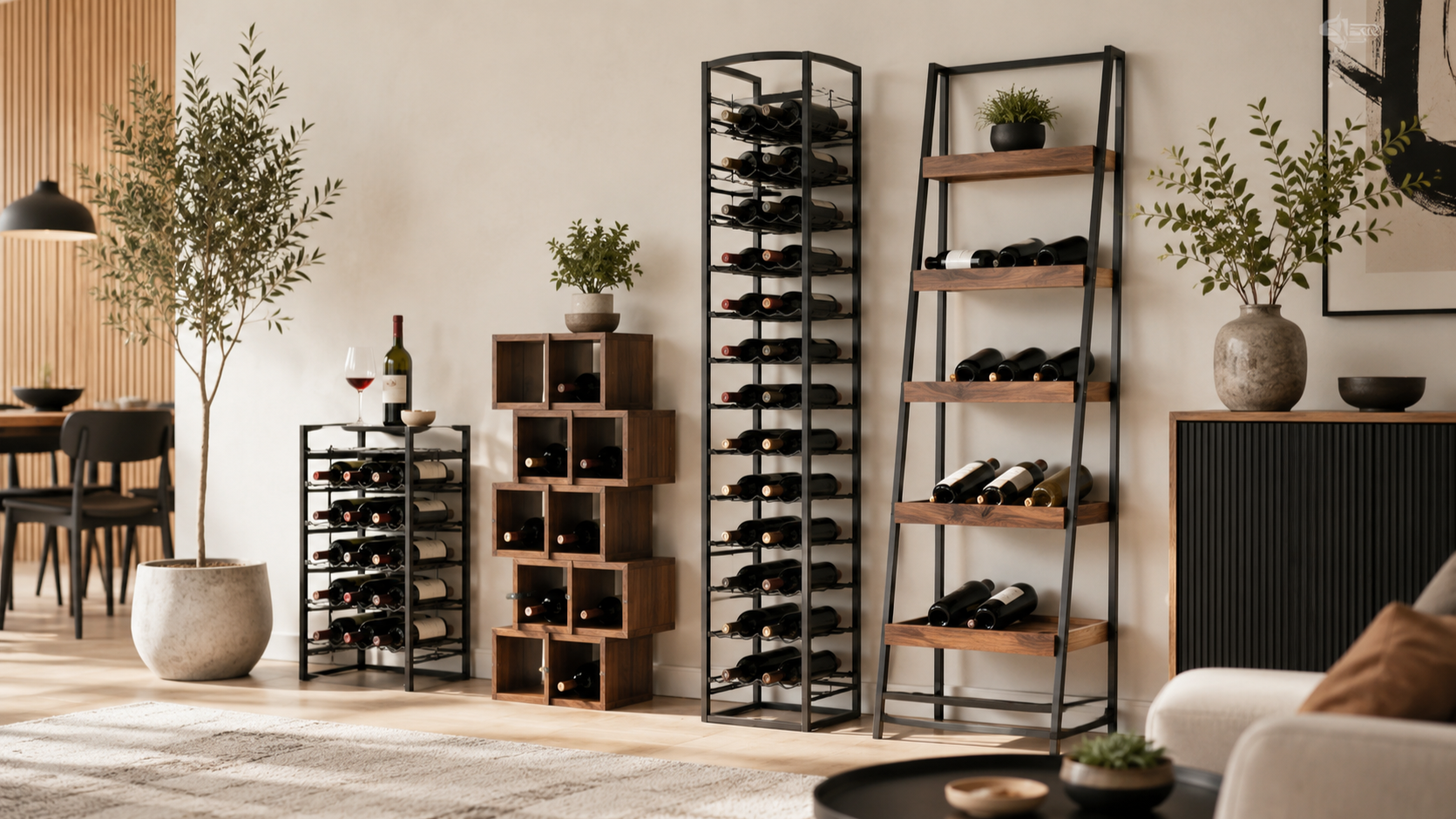
Most wine racks are designed for people who want a cellar aesthetic. Dark wood, ornate ironwork, the visual language of a Tuscan restaurant. If you have a modern apartment or a clean contemporary home, those racks look immediately wrong.
The other extreme is worse: ultra-minimal designs that photograph well but only fit standard Bordeaux bottles, tip forward when loaded, and fall apart within a year.
This guide focuses on the middle ground: racks that look intentional in modern spaces, handle real collections including Champagne and Burgundy bottles, and do not require you to commit to a furniture piece the size of a bookshelf.
Affiliate Disclosure: This post may contain affiliate links. As an Amazon Associate and through other affiliate programs, I earn from qualifying purchases at no additional cost to you.
Best Modern Wine Racks at a Glance
| Wine Rack | Best For | Highlights | |
|---|---|---|---|
| Sorbus Freestanding Floor Wine Rack Top Pick | Best Overall & Large Capacity | Minimal modern design with multiple capacity options and good bottle compatibility | View on Amazon |
| Sorbus Compact Freestanding Wine Rack | Best Small Space | Compact footprint that works well in smaller spaces | View on Amazon |
| Wine Enthusiast Galerie Leaning Ladder Rack | Best Statement Piece | Decor-forward leaning ladder design that doubles as display storage | View on Amazon |
| Wine Enthusiast Anjou Modular Wine Rack | Best Vertical Capacity | Expandable vertical modular storage with a cleaner modern look | View on Amazon |
| Modular Wine Cube Rack Best Value | Best Starter Wine Rack | Expandable modular cube system available in multiple finishes | View on Amazon |
The Reviews
Sorbus Freestanding Floor Wine Rack
Best Overall
Most minimalist wine racks fail the moment you try to store anything wider than a standard Bordeaux bottle. Champagne bottles, Burgundy bottles, and wider Pinot Noir formats simply do not always fit in racks designed with tight spacing for visual cleanliness. The larger Sorbus freestanding rack is one of the few clean-lined options that handles mixed collections and can be found in varying capacity options.
Pros
Generous slot spacing fits Champagne and wider Burgundy bottles
Matte black finish reads modern without being industrial-heavy
Multiple capacity configurations available
Cons
End slots can run slightly tight with the widest bottle formats
Industrial aesthetic does not suit every home style
Needs wall anchoring for safety and assembly
Verdict
I have two of these in my own home. That is probably the most useful thing I can tell you. After trying other options, the Sorbus is the rack that actually stayed. It handles mixed bottle formats without forcing, looks right in a modern space, and holds up over time. For most people this is the right starting point and likely the only rack they will need.
Best for: mixed collections, apartment kitchens, buyers who prioritize practicality alongside aesthetics.
Sorbus Compact Freestanding Wine Rack
Best for Small Spaces
This is the same design language as the larger Sorbus scaled down for tighter spaces. What separates it from other budget-friendly compact racks is that it still looks intentional rather than like an afterthought. A lot of small wine racks in this price range feel like dorm room furniture. This one holds its visual weight without dominating the space.
Pros
Compact footprint suits apartments and smaller kitchens, multiple size options
Affordable entry point
Simple assembly
Cons
Smaller capacity limits usefulness as a collection grows
Less visual impact than larger statement racks
Verdict
I have had the compact version in my office and have repurchased it. At this size and price point, nothing else comes close for what it does. If you keep a rotating stock of bottles in a smaller space and want storage that looks considered rather than purely functional, this is the one to buy.
Best for: renters, casual wine drinkers, anyone who keeps fewer than 15 bottles on hand at a time.
Wine Enthusiast Vino Galerie Leaning Wine Rack
Best Statement Piece
Every other rack in this guide is storage that happens to look good. This one is a design object that happens to store wine. The leaning ladder format gives it a completely different presence in a room, and in open-concept spaces or living areas where the rack is visible from multiple angles, that distinction matters. It reads as furniture rather than utility storage.
Pros
Visually distinctive leaning ladder format
Functions as a display piece and storage simultaneously
Open and airy visual footprint
Works well in styled living spaces and entertaining areas
Cons
Lower storage density than standard floor racks
Takes more floor space than compact freestanding options
Better suited to display than high-volume storage
Verdict
If aesthetics are the primary consideration and the rack is going to live somewhere prominent, this is the strongest option in the group. Do not buy it if maximum bottle capacity is the goal. Do buy it if you want the rack to feel like part of the room.
Best for: open-concept living spaces, styled interiors, curated collections of 12 to 20 bottles.
Wine Enthusiast Anjou Modular Wine Rack
Best Vertical Tower Option
Most freestanding wine racks spread horizontally, which works fine until the rack starts competing with everything else in the room for visual real estate. The Anjou takes a different approach. The vertical tower format draws the eye upward rather than outward, which gives it a significantly smaller floor footprint than its capacity suggests and makes it feel more like a furniture piece than a storage solution.
Pros
Vertical tower format minimizes floor footprint
Modular system allows gradual expansion
Reads more like furniture than utility storage
Cleaner look than most tower-style racks
Cons
78 bottle capacity is solid but well below the larger Sorbus
More visually substantial than compact minimalist options
Better suited to medium or larger spaces
Verdict
If you want storage that draws the eye up rather than out, this is the strongest option in the guide for that. The modular structure is a genuine advantage over fixed tower racks: start with one unit and expand vertically rather than replacing the whole thing later.
Best for: tighter floor footprints, buyers who prefer vertical storage, spaces where the rack needs to read as furniture.
Modular Wine Cube Rack
Best Starter Rack
The modular cube format is the smartest choice for new wine drinkers for one specific reason: you do not have to guess how much storage you will eventually need. Start with one cube, add another when your collection grows, and never end up with either a half-empty oversized rack or an undersized one you need to replace in a year. The softer furniture-like aesthetic also works in warmer or more Scandinavian-leaning interiors where matte black industrial styling would feel out of place.
Pros
Expandable modular system grows with your collection
Multiple finish options suit different home styles
Compact starter footprint
Softer aesthetic works in non-industrial interiors
Good value
Cons
Smaller individual capacity per unit
Less visually dramatic than premium designs
Verdict
The flexibility here is worth more than the aesthetics. If you are new to wine or building a collection gradually, this is the most practical long-term starting point. You are buying a system, not just a rack.
Best for: new wine drinkers, gradual collection builders, interiors that lean warmer or more Scandinavian.
What Actually Matters When Buying a Wine Rack
Bottle compatibility
This is the most overlooked spec and the most common source of buyer regret. Champagne bottles are noticeably wider than standard 750ml Bordeaux bottles. Burgundy and Pinot Noir bottles have a wider shoulder profile. Minimalist racks with tight slot spacing often cannot accommodate these formats.
Before buying, check whether the rack explicitly lists Champagne bottle compatibility. If it does not, assume it is designed for Bordeaux-format bottles only. If you drink sparkling wine regularly, this matters more than almost any other spec.
How much storage you actually need
The most common mistake is buying too much capacity. A half-empty 48-bottle rack looks worse than a smaller full one, and it dominates the space in a way that rarely feels intentional. For most casual wine drinkers, 12 to 24 bottles is the right range. Modular systems are the smarter choice if you are unsure, since you can scale without replacing the whole rack.
Where the rack lives
A rack in a temperature-stable kitchen or dining room is fine for bottles you plan to drink within a few months. Avoid direct sunlight, proximity to a stove, or anywhere with significant temperature swings. If your storage location regularly exceeds 70 degrees Fahrenheit, a wine fridge is the more honest solution.
Freestanding vs wall-mounted
Freestanding racks suit most people: renters, flexible layouts, growing collections. Wall-mounted racks make sense when floor space is the genuine constraint or when the rack is part of a designed display wall. If you are unsure, go freestanding.
FAQ
What is the best wine rack for a minimalist home?
A clean-lined freestanding rack with a matte or natural finish works best in minimalist interiors. Avoid ornate hardware or heavy traditional styling. The larger Sorbus freestanding rack is the strongest overall option for most modern homes.
Do wine racks fit Champagne bottles?
Most minimalist racks do not by default. Champagne bottles are wider than standard wine bottles, and racks with tight slot spacing cannot accommodate them. Open-frame designs with generous spacing, like the larger Sorbus, handle wider formats better. Always check compatibility explicitly if you store sparkling wine.
How many bottles should a wine rack hold?
For most casual wine drinkers, 12 to 24 bottles is the right range. Buying more capacity than you need results in a rack that always looks half-empty, which reads as clutter rather than collection. If you are unsure how your needs will grow, a modular system is the smarter starting point.
Are modular wine racks worth it?
Yes, particularly for anyone building a collection gradually. Starting smaller and expanding over time is more practical than guessing your eventual storage needs upfront. The JAXPETY cube system is the best entry point; the Anjou modular rack is the better option once collections grow larger.
Can I store wine at room temperature?
For bottles you plan to drink within a few months, yes. Wine racks are not long-term aging solutions. Anything stored for a year or more benefits from consistent temperature control that a rack cannot provide. If you regularly keep bottles for extended periods, a wine fridge is the right tool.
What is the difference between a wine rack and a wine fridge?
A wine rack stores bottles at ambient room temperature with no climate control. A wine fridge maintains a consistent temperature, typically 55 to 65 degrees Fahrenheit, with humidity control. For short-term storage of bottles you are actively drinking through, a rack is fine. For longer storage or bottles you paid serious money for, a wine fridge is the better investment.
Can renters use wine racks?
Freestanding racks are ideal for renters since they require no installation and move with you. Wall-mounted racks require drilling and may not be appropriate without landlord approval. If you rent, stick to freestanding options.