The Best Walkable Wine Towns in America for a Flexible Weekend Getaway
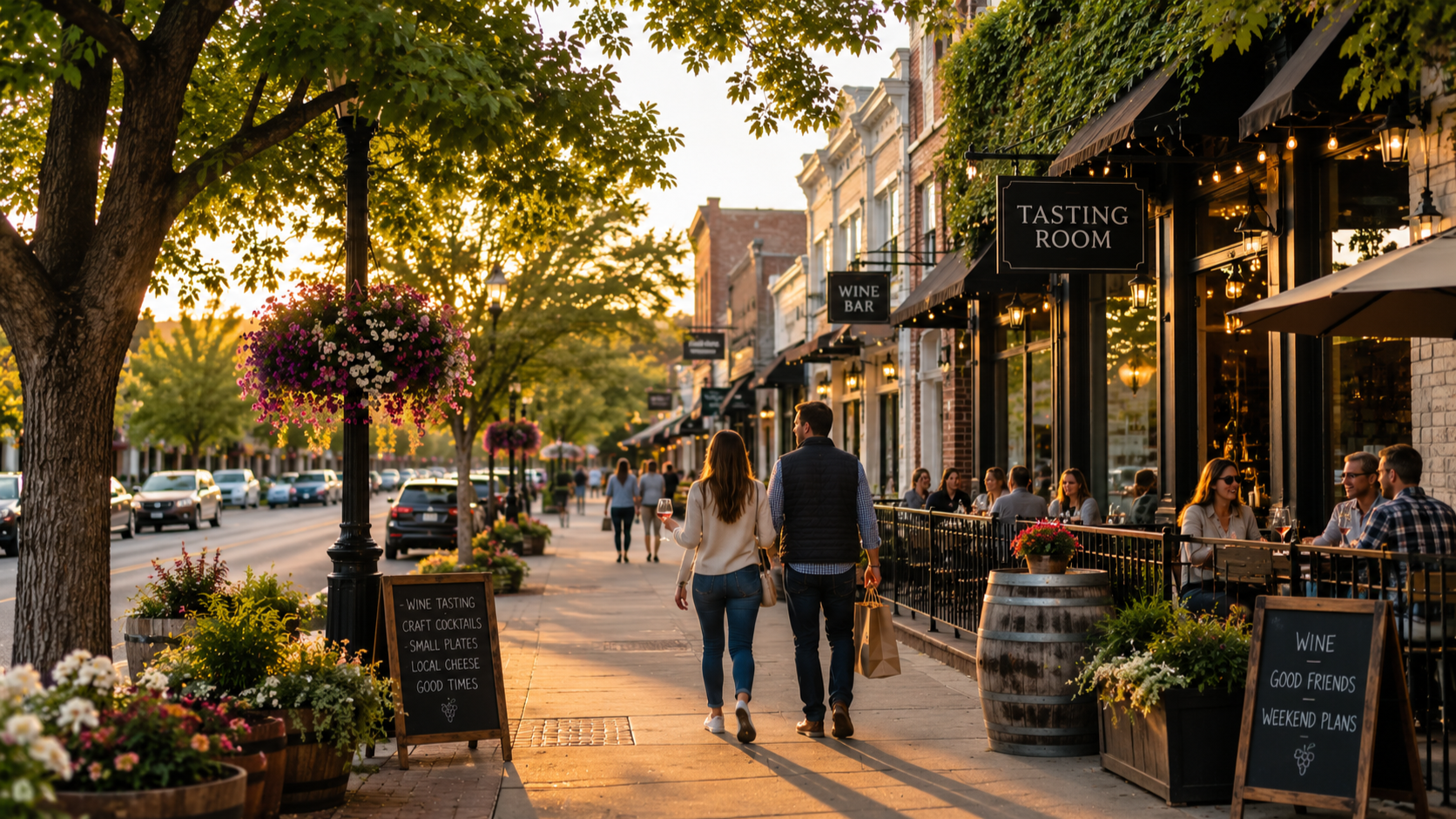
Most wine travel guides are built around regions.
Napa Valley. Sonoma County. Willamette Valley. Finger Lakes.
The problem is that regions don't tell you whether you need a reservation three months out just to get in somewhere decent, or whether you'll spend the whole weekend behind the wheel instead of actually enjoying yourself. Most wine regions are designed around driving between appointments, not wandering. You spend half the weekend in a car and the other half on someone's tasting schedule, not your own.
After more than a decade working in wine professionally, I've come to believe the best wine weekends are rarely the ones with the most winery checkboxes. They're the ones that leave room to breathe. You wander into a tasting room you hadn't planned on visiting. Someone behind the bar tells you about a producer two blocks over you'd never have found otherwise. You have a great lunch by accident and end up staying two hours longer than you meant to.
That's the lens I used for this guide. These aren't necessarily the most famous wine destinations in the country. They're the towns where you can step off a plane, get to your hotel, and spend the weekend at your own pace.
A note on what 'walkable' means here: each of these towns has a downtown core where you can taste, eat, and wander on foot. The vineyards and rural wineries are still out there and worth visiting. They're just a short drive or rideshare away when and if you want them. And while advance reservations are always smart during peak season, downtown tasting rooms give you a much better shot at walking in without one than their vineyard counterparts do.
You'll notice this guide is more specific about hotels than about individual wineries or restaurants. That's intentional. Wine and food are forgiving. A mediocre glass or an average lunch is a minor inconvenience. A bad hotel ruins the weekend. If you're doing a last-minute trip, the tasting rooms and restaurants will sort themselves out. The hotel is the one thing worth deciding in advance, and I've done that vetting so you don't have to.
Affiliate Disclosure: This post may contain affiliate links. As an Amazon Associate and through other affiliate programs, I earn from qualifying purchases at no additional cost to you.
What Makes a Great Weekend Wine Town?
This isn't a ranking of America's best wine regions. It's a guide to wine towns, which is a different category entirely.
To make the cut here, a destination had to deliver on five things: wine that's genuinely worth the trip, a walkable core where you can spend real time on foot, reasonable airport access, food that reflects the surrounding region rather than just serving the tourist crowd, and enough flexibility that you don't need a color-coded itinerary binder to have a good time.
That last one matters more than people give it credit for when it comes to a relaxing weekend.
Best Time to Visit
The short answer is that any of these towns rewards a visit year round. The longer answer depends on what you're optimizing for.
Harvest Season: September through October
This is the most alive these towns get. Wineries are running full operations, there's genuine energy in the air, and if you visit any of the California destinations during crush you'll smell fermentation before you see a single tasting room sign. For anyone with a professional or serious amateur interest in wine, there's nothing quite like it.
The tradeoff is that everyone else knows this too. Hotel prices spike, tasting rooms get crowded, and the best places to stay book up weeks or months in advance. If harvest is your target window, plan earlier than you think you need to.
Spring: March through May
Probably the most underrated window. Vines are budding, cover crops are green, the landscapes are genuinely beautiful, and the crowds haven't arrived yet. Weather in the California destinations is mild and pleasant, a great way to shake off the winter if you live in a colder area. Prices are reasonable. This is the sweet spot for people who want the wine country aesthetic without the harvest chaos.
Summer: June through August
Peak season in terms of visitors and pricing, particularly for the California towns. The weather is warm, everything is open, and the energy is high. If you're going to Traverse City, summer is when the Great Lakes waterfront comes fully alive and is worth prioritizing. For the California destinations, summer is fine but it's the most expensive and most crowded window without the added drama of harvest.
Off-Season: November through February
Here's the honest truth about winter wine country that most travel guides skip: the vines look like dead sticks. If you're driving between rural wineries and expecting a picturesque vineyard landscape, January in Sonoma County is going to disappoint you.
But here's what most guides also miss: if you're staying in town, it barely matters. The tasting rooms are still open. The restaurants are still excellent. The hotels drop significantly in price. And for most of the country, escaping to California in January or February, even a rainy one, is a reasonable life decision. Healdsburg, Sonoma, and Santa Barbara in the off-season are still Healdsburg, Sonoma, and Santa Barbara. You're just paying less for them.
The one thing you genuinely lose in winter is the liveliness of harvest operations at working wineries. That energy exists at the source, in cellar visits, in production facilities, in the rhythm of a winery running at full capacity. Downtown tasting rooms don't have that in January regardless of what's happening outside. But if your weekend is built around the town rather than the vineyard, the off-season is a legitimate and underappreciated option.
For the non-California destinations, winter carries more weather risk worth factoring in. Traverse City in January is a different proposition than Santa Barbara in January. Walla Walla and Charlottesville fall somewhere in between.
The towns below are the ones I keep coming back to, or keep recommending when someone asks where to go. They're not the only great wine destinations in the country, but they're the ones that check every box on that list without requiring you to plan like you're organizing a military operation.
1. Healdsburg, California
Healdsburg is essentially my backyard. I got my start in wine here, and I've spent years since tasting through these appellations with the kind of attention you develop when wine is your profession. It also happens to sit at the confluence of three distinct wine appellations: Russian River Valley, Dry Creek Valley, and Alexander Valley. That's world class Pinot Noir, Chardonnay, old vine Zinfandel, and Cabernet Sauvignon all within a short drive of the same town square. From a pure wine geography standpoint, it's hard to beat.
But what actually makes Healdsburg work as a weekend destination is how little planning it requires. Downtown revolves around a beautiful central plaza, and the tasting rooms, restaurants, bakeries, and wine bars all orbit that square in walking distance. A significant number of producers here still welcome walk-ins, which is increasingly rare in California wine country. You can roll in on a Friday afternoon with nothing booked and still have an excellent weekend.
One thing visitors often overlook: don't sleep on the Mexican food. People arrive expecting farm-to-table restaurants and leave surprised that some of the best meals they had came from a taco spot with a short menu and a long line.
If you're planning to bring bottles home, think ahead on transport. A good wine travel bag saves you the choice between checking luggage and shipping. We cover the best options in our guide to wine travel bags.
What to drink: Pinot Noir and Chardonnay from Russian River, old-vine Zinfandel from Dry Creek, Cabernet from Alexander Valley.
Getting here: Sonoma County Airport (STS) is the closest option. San Francisco (SFO) works fine and is about 90 minutes in normal traffic. Rideshare exists but can be unreliable for anything outside the downtown core, so plan ahead if you're doing winery visits further out and definitely schedule ahead in the app for a pick up to get back to the airport.
Where to stay:
Luxury Pick: Hotel Healdsburg- hard to beat for travelers who want luxury accommodations and immediate access to Healdsburg's plaza, tasting rooms, restaurants, and shops.
Mid-Range Pick: Harmon Guest House - a great fit for travelers who want a modern, upscale stay with excellent walkability and a slightly more contemporary feel than many traditional wine-country hotels.
Best Value Pick: The Lodge at Healdsburg- works well for travelers who don't mind being about a mile from the plaza in exchange for more space, easier last-minute availability, and strong overall value.
Resort Splurge: Montage Healdsburg - best reserved for travelers seeking an ultra-luxury wine-country retreat, with a secluded vineyard setting less than three miles from downtown.
2. Sonoma, California
Sonoma is the other town I keep coming back to, it is the slower, more historically grounded sibling to Healdsburg's trendier energy. The central plaza here is genuinely one of the most pleasant town squares in California, ringed by tasting rooms, restaurants, and a handful of landmarks that make this one of the state's more historically significant small towns. Mission San Francisco Solano, the last mission established in California, sits at the edge of the square. The Sonoma Barracks, a preserved adobe structure from the Mexican era, anchors the northeast corner and played a direct role in the Bear Flag Revolt.
The wine draws from the same Sonoma County pool, with Chardonnay, Pinot Noir, and Cabernet well-represented. Like Healdsburg, you can do a lot of good tasting downtown without ever getting in a car, and the food scene genuinely reflects the surrounding agricultural region rather than just catering to tourists.
Napa gets more attention in travel conversations, but Sonoma consistently delivers the same quality with less pressure and shorter waitlists. That's worth something.
Getting here: Sonoma County Airport (STS), Oakland (OAK), and San Francisco (SFO) are all reasonable options. Sonoma sits in a position where it's roughly equidistant from all three, usually 50 minutes to 90 minutes depending on traffic.
Where to stay:
Luxury Pick: MacArthur Place Hotel & Spa-ideal for travelers who want a luxury wine country retreat while remaining within walking distance of Sonoma Plaza.
Mid-Range Pick: El Dorado Hotel- a great choice for travelers who want boutique hotel charm and one of the most convenient locations in Sonoma for exploring on foot.
Best Value Pick: Sonoma Hotel- well suited for travelers who value historic character and a prime plaza location over luxury amenities.
3. Santa Barbara, California
Santa Barbara is the one destination on this list that doesn't feel like traditional wine country, and that's the point.
The Funk Zone, a redeveloped industrial corridor between downtown and the waterfront, contains a walkable cluster of tasting rooms, restaurants, and breweries that make it possible to spend a full afternoon on foot, glass in hand, without touching a car. The surrounding region produces some of California's most exciting cool-climate wine: Pinot Noir and Chardonnay from the Sta. Rita Hills, Syrah from the Santa Ynez Valley, producers who are doing genuinely interesting work without the ego overhead you sometimes get in Napa. I say that having worked in Napa. It's fine.
Then there's the coast. A beach walk, Stearns Wharf, and fresh seafood are all within easy range of the wine corridor, which makes Santa Barbara the easiest destination on this list to sell to a travel companion who isn't primarily wine-motivated.
Getting here: Santa Barbara Airport (SBA) is small but well-connected and puts you close to everything. It's also one of the more manageable airports to fly through.
Where to stay:
Luxury Pick: Hotel Californian- hard to beat for travelers who want luxury accommodations and one of the best locations in Santa Barbara for exploring the Funk Zone, waterfront, and nearby tasting rooms on foot.
Mid-Range Pick: Kimpton Canary Hotel- works especially well for travelers who want a stylish, centrally located hotel that makes it easy to explore downtown Santa Barbara without a car.
Best Value Pick: Hotel Santa Barbara- for travelers who value historic character, walkability, and a convenient downtown location over luxury amenities.
4. McMinnville, Oregon
If you care about Pinot Noir, McMinnville is worth understanding on its own terms.
The town sits at the heart of the Willamette Valley, which produces some of the most compelling Pinot Noir made in this country. The style here runs cooler and more structured than California equivalents, with more red fruit, more savory character, and more obvious site expression when the wine is made well. It's a style that tends to resonate more with wine drinkers who've been at it for a while.
Third Street runs through the center of town and is dense with tasting rooms, restaurants, and independent shops. It's a genuinely walkable downtown in a way that smaller wine towns sometimes aren't, and the food scene is legitimately good. Willamette Valley's agricultural output includes hazelnuts, berries, mushrooms, artisan cheeses, and Pacific Northwest seafood that shows up in kitchens here in ways that feel earned rather than curated.
Portland International (PDX) is the closest major airport, about an hour away.
Where to stay:
Luxury Pick: Atticus Hotel- great for travelers who want McMinnville's most refined hotel experience while staying just steps from Third Street's tasting rooms, restaurants, and shops.
Mid-Range Pick: Compass Hotel- perfect for travelers who want modern accommodations, inviting outdoor spaces, and a relaxed wine country atmosphere for a weekend getaway.
CharacterPick: McMenamins Hotel Oregon- best for travelers who appreciate historic character, quirky charm, and one of the most distinctive stays in Oregon wine country.
5. Walla Walla, Washington
Walla Walla punches significantly above its weight. The wine, anchored by Cabernet Sauvignon, Merlot-based blends, and Syrah, is serious in a way that doesn't always get the national attention it deserves. The town has grown its wine reputation over the past two decades without losing the small-town feel that makes it worth visiting in the first place.
Downtown has a meaningful concentration of tasting rooms in walking distance, which matters. The food scene reflects one of the country's genuinely productive agricultural pockets: local beef, produce, wheat, and the famous Walla Walla sweet onion all appear in kitchens around town in ways that go beyond novelty.
Walla Walla Regional Airport (ALW) is the closest option and worth checking first.
Where to stay:
Luxury Pick: Eritage Resort- for travelers who want a true wine country retreat and don't mind a short ride into downtown in exchange for vineyard views and resort style amenities.
Mid-Range Pick: Marcus Whitman Hotel - best for travelers who want historic character and the convenience of staying within walking distance of Walla Walla's tasting rooms, restaurants, and shops
Best Value Pick: The FINCH - nice for travelers who want a stylish, modern stay with an easy walk to downtown while keeping costs reasonable.
6. Traverse City, Michigan
Traverse City doesn't get the same national recognition as the West Coast destinations on this list, and if you've been looking for somewhere that feels genuinely undiscovered, that's your opportunity.
The region produces excellent cool-climate wines, particularly Riesling, Pinot Gris, and sparkling, in a style shaped by Lake Michigan's moderating influence. The downtown waterfront is compact and walkable, with tasting rooms, restaurants, and local businesses in an easy walkable cluster. And the backdrop is different from anything else on this list: Lake Michigan and Grand Traverse Bay, beaches, boat tours, and a regional food identity built around Great Lakes whitefish and, if you're here at the right time of year, cherries that show up in everything.
Cherry Capital Airport (TVC) lives up to its name and is a straightforward entry point.
Where to stay:
Luxury Pick: Delamar Traverse City - fantastic for travelers who want the most polished hotel experience in Traverse City, with waterfront views, upscale accommodations, and easy access to downtown.
Alternative Pick: Hotel Indigo Traverse City- suited for travelers who prefer the familiarity of a major hotel brand or need an excellent backup option when Delamar is sold out.
Best Value Pick: Bayshore Resort- ideal for travelers who want waterfront views and a convenient location while keeping more room in the budget for wine, food, and exploring.
7. Charlottesville, Virginia
Charlottesville makes the case that great American wine destinations aren't exclusively a West Coast story.
Virginia has been producing wine worth paying attention to for longer than most people realize, with Viognier and Cabernet Franc as the regional anchors and an emerging track record with Bordeaux-style blends. The region's winemakers have developed a regional voice that doesn't feel derivative of California or France, which makes it worth exploring on its own terms.
The pedestrian-friendly Downtown Mall gives the city a walkable center that works well as a weekend home base. The food scene pulls from Virginia's agricultural traditions: local cheeses, orchard fruit, Virginia ham, seasonal produce, and a Southern influence that shows up without being heavy-handed. And if you're coming from the East Coast and want to skip the long-haul flight entirely, Charlottesville-Albemarle Airport (CHO) is a short hop from most major hubs.
Where to stay:
Luxury Pick: Omni Charlottesville Hotel - Located beside the Downtown Mall, it is perfect for travelers who want upscale accommodations and one of the most convenient locations in Charlottesville.
Boutique Pick: The Draftsman - a great choice for travelers who prefer a more intimate, design forward experience over a traditional luxury hotel.
Best Value Pick: Graduate Charlottesville - for travelers who want a comfortable, personality filled stay without paying luxury hotel prices.
Resort Alternative: Keswick Hall- Located about six miles from downtown, it is best for travelers who want a luxury countryside retreat rather than a walkable town experience.
Final Thoughts
The best wine weekends aren't always the most planned ones.
The ones I remember most clearly from years of working in wine usually involved some version of the same thing: finding something I didn't expect, in a place I might have walked past. A small producer in a converted warehouse. A lunch that turned into three hours. A bottle from a vintage I wouldn't have picked on my own.
Every town on this list makes that kind of weekend possible. Good wine, walkable neighborhoods, food that's connected to where you are, and room to follow your curiosity instead of an itinerary.
That's the point.
Frequently Asked Questions
Do I need to book winery appointments in advance? For most of the towns on this list, no. That's part of why they made the cut. Downtown tasting rooms in places like Healdsburg, Sonoma, and McMinnville tend to welcome walk-ins, especially on weekdays. If there's a specific producer you're set on visiting, a quick check of their website before you go doesn't hurt. But you shouldn't need to plan your whole weekend around a reservation calendar.
Do I need to rent a car? For a downtown-focused weekend, probably not. Most of these towns are designed around a walkable core, and rideshare covers the gaps. If you want to venture out to rural wineries or vineyard estates, a car gives you more flexibility. But plenty of people do these weekends entirely on foot and rideshare without feeling limited.
What's the best time of year to visit? Harvest season, roughly September through October, is the most atmospheric time to visit any wine region. The towns are buzzing, the vineyards are active, and there's an energy you don't get in February. That said, it's also peak pricing and peak crowds. Spring and early fall offer a good balance of decent weather and fewer people. Winter is genuinely pleasant in the California destinations if you don't mind the occasional rain.
How far in advance should I book a hotel? For a standard weekend, four to six weeks is usually enough for most of these destinations outside of harvest season and major local events. Walla Walla and Traverse City book up faster than you'd expect given their size. Healdsburg and Sonoma during harvest can be tight even further out. If you're planning a last-minute trip, midweek is significantly easier than weekends.
Are these destinations good for non-wine drinkers? Honestly, all of them yes, some more so than others. Healdsburg and Sonoma are built around beautiful town squares with independent shops, restaurants, galleries, and coffee that have nothing to do with wine. Santa Barbara has the coast. Traverse City has Lake Michigan. Charlottesville has history and architecture. McMinnville has genuinely good food. The wine is the anchor but it doesn't have to be the whole trip.
Related Guides
Best Wine Travel Bags for Bringing Bottles Home
The easiest ways to safely transport wine when flying home from a wine country weekend.How to Taste Wine Like a Pro (Without Feeling Intimidated)
A simple framework for getting more out of winery visits and tasting room flights.Common Wine Terms Explained
A practical guide to the wine vocabulary you'll encounter in tasting rooms and winery conversations.How to Read a Restaurant Wine List Without Feeling Overwhelmed
Learn how to quickly spot good values, understand wine list organization, and order with confidence while traveling.How to Pair Wine With Food: A Simple Beginner's Guide That Actually Makes Sense
A straightforward approach to choosing wines with meals while traveling through wine country.