Best Wine & Liquor Travel Bags for Bringing Bottles Home (Leak-Proof Options That Actually Work)
You spent time planning the trip.
Reservations booked. A few wineries or distilleries you actually cared about. Maybe you even left space in your suitcase, just in case you found something worth bringing home.
Then you do.
A bottle you didn’t expect to love. Then another.
Maybe something rare you can only get at the producer… which makes getting it home feel a little higher stakes.
I learned the hard way that getting it home is the part people underestimate (which is especially painful when you work in wine and should absolutely know better)... so learn from my mistake instead of repeating it.
A couple months ago, I brought back a few bottles of 18-year-old Scotch from Scotland. I packed them carefully in their cardboard tubes, wrapped in winter sweaters in my hardshell luggage, and figured that would be enough, as it had times before.
It wasn’t.
As soon as I grabbed my bag off the baggage claim carousel, I caught that faint smell of vanilla and honey and my heart dropped. Before I even opened the suitcase, I knew one of the bottles had broken.
Luckily it wasn’t red wine. That would’ve been a much bigger problem. But still… not how you want to end an otherwise amazing trip.
That’s the moment wine travel bags are actually for.
Not to make bottles indestructible, but to control the two things that matter when you’re flying home with glass in your suitcase: impact and leaks.
This guide covers the options that actually work in checked luggage, and how to pack wine or liquor so you don’t end your trip the same way.
Affiliate Disclosure: This post may contain affiliate links. As an Amazon Associate and through other affiliate programs, I earn from qualifying purchases at no additional cost to you.
In This Guide
What wine travel bags actually do (and don’t do)
The best wine & liquor travel bags for checked luggage
How to pack bottles safely (without overthinking it)
Wine vs liquor travel differences (what actually matters)
FAQs about flying with alcohol
What Wine Travel Bags Actually Do
A lot of products overpromise here. Let’s simplify it.
Wine travel bags are designed to solve two problems:
1. Impact protection
Padding reduces the chance of breakage when your bag gets handled like… luggage.
2. Leak containment (this is the big one)
If a bottle does break, a good sleeve keeps liquid and glass shards contained so it doesn’t soak your clothes.
That second point is what separates good from useless.
A broken bottle is annoying. A leaked bottle ruins your entire suitcase.
The Best Wine & Liquor Travel Bags for Checked Luggage
These are curated to cover different use cases, not just variations of the same thing.
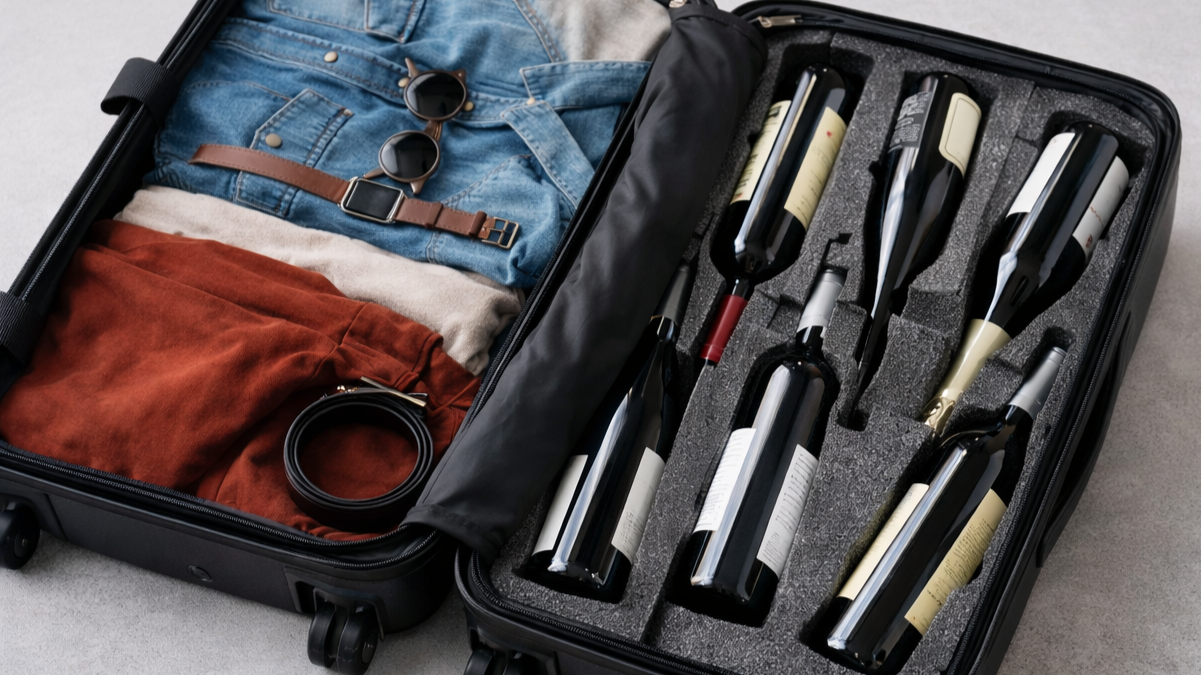
VinGardeValise Wine Travel Suitcase — Best Overall
A dedicated wine suitcase designed specifically for transporting bottles safely.
Specs
Capacity: 8–12 bottles (depending on configuration)
Hard-shell exterior
Removable foam inserts
Pros
Maximum protection
Built specifically for wine travel
Great for winery trips or bringing back multiple bottles
Will fit standard liquor bottles
Flexible packing (can remove one side of inserts for clothes)
Cons
Expensive
Bulky compared to standard luggage
No leak containment if a bottle breaks
Verdict
If you regularly travel with wine, this is the cleanest, lowest-risk solution.
The ability to split it into wine on one side, clothes on the other makes it far more practical than it looks at first glance. I use it for short work trips frequently.
Liquid Spectrum Reusable Wine Protector — Best for Most People
Flexible, padded sleeves with a sealed outer vinyl layer.
Specs
Fits standard 750 mL bottles
Leak-proof seal
Reusable
Pros
Very affordable
Excellent leak protection
Lightweight and packable
Good for occasional travel
Easy to use
Cons
Limited structure compared to hard cases
Verdict
Great for a one-off trip or if you don’t want to invest in reusable gear.
Lazenne Wine Carrier Bag — Best for Winery Trips & Road Travel
A structured, insulated carrier designed for transporting bottles between stops, not for tossing into checked luggage.
Specs
Capacity: 6 bottles
Removable divider system
Shoulder strap + carry handles
Insulated interior
Pros
Easy to carry from winery → car → hotel
Wheels make it effortless to move when loaded
Insulation helps protect bottles from heat in the car (add ice packs if needed)
More structure than basic sleeves
Cons
Not designed for air travel or baggage handling
Limited impact protection compared to hard cases
Verdict
Perfect for winery days, road trips, or any situation where you’re moving bottles short distances. Not built for flights, but excellent for everything leading up to them.
Pelican Case with Bottle Inserts — Best Maximum Protection
Overbuilt, nearly indestructible case adapted for bottles.
Specs
Hard waterproof shell
Customizable foam
Airline-safe
Pros
Extremely durable
Waterproof and crush-resistant
Ideal for high-value bottles
Cons
Heavy
Expensive
Not space-efficient
Foam bottle inserts must be customized yourself or purchased separately (see pre-designed inserts here)
Verdict
For rare or expensive bottles, this is as safe as it gets.
Best Wine Travel Bags at a Glance
| Product | Best For | Capacity | |
|---|---|---|---|
| VinGardeValise Wine Suitcase Top Pick | Best Overall | 8–12 bottles | Check Price |
| Liquid Spectrum Reusable Wine ProtectorBest Value | Best For Most People | Single bottle | Check Price |
| Lazenne Wine Carrier | Best for Winery Trips & Road Travel | 4–6 bottles | Check Price |
| Pelican Case (with Bottle Insert) | Maximum Protection | Varies | Check Price |
How to Pack Wine or Liquor in Checked Luggage (The Right Way)
You don’t need a complicated system. Just follow this:
1. Seal the bottle first
Even with a cork or screw cap, add a quick layer:
plastic wrap
or a small bag
It’s cheap insurance.
2. Use a leak-proof sleeve
This is non-negotiable.
Padding helps.
Leak containment saves your clothes.
3. Place bottles in the center of your suitcase
Surround them with soft items:
jeans
sweaters
towels
Avoid edges and corners.
4. Don’t overpack bottles
Six bottles sounds reasonable… until you lift your suitcase.
6 bottles = roughly 9–10 pounds
That adds up fast.
How to Pack Wine or Liquor in a Suitcase (Last-Minute Fix That Actually Works)
Don’t have a wine travel bag with you? Here’s what to do instead.
If you’re reading this from your hotel room the night before your flight, you’re not alone. This is exactly when most people realize they have no real plan for getting bottles home safely.
There’s a simple fix that works surprisingly well.
Ask the winery (or tasting room) if they have a styrofoam shipping insert. Most do, especially the 3-bottle versions used for shipping orders.
These are designed to survive actual shipping conditions, which means they’re more than capable of handling a flight in your suitcase.
How to use it
Grab a 3-bottle styrofoam insert
Place it inside one half of your suitcase (the flat side of a clamshell works best)
Pack clothing tightly around it for added cushioning
If space is tight, move some clothes into a carry-on
That’s it. No complicated setup.
It’s not the most elegant solution, but it’s reliable.
This is a lot better than wrapping bottles in sweaters and hoping for the best.
And it’s not a hack, either.
This is how wineries safely ship bottles across the country. You’re just using the same system inside your luggage.
Wine vs Liquor Travel: What’s Actually Different
Short answer: not much.
Shape matters more than content
Wine bottles are consistent.
Liquor bottles vary a lot.
Some wider or oddly shaped bottles won’t fit standard sleeves.
Glass thickness isn’t a guarantee
Spirits bottles can feel heavier, but they still break.
Alcohol content doesn’t matter (for packing)
For checked luggage, you don’t need to overthink ABV.
This isn’t about chemistry. It’s about physics.
The real rule
If it fits a standard 750 mL sleeve, it travels the same.
Shipping Wine from Wineries (What Most People Don’t Realize)
Shipping sounds like the easy solution. Sometimes it is. But there are a couple things most people don’t realize until they’re already on the trip.
Wineries can typically only ship their own bottles, not a mixed case from multiple producers. That’s due to licensing and compliance rules, not convenience.
So if you’re visiting several wineries and buying a few bottles at each, you usually can’t combine everything into one shipment at the end.
That means you’re left with two options:
Ship smaller quantities from each winery
Or carry everything with you
And unless you’re buying a full case at each stop, shipping costs can add up quickly.
You might think about packing everything up and shipping it yourself through a UPS or FedEx store instead.
In reality, that’s usually not a great option.
Most carriers have restrictions around shipping alcohol, and retail locations often won’t accept it unless it’s going through a licensed shipper. Even when they do, you’re paying high retail shipping rates, plus packaging.
Between the cost and the hassle, privately shipping a few bottles is usually the most expensive and least efficient option.
Shipping makes the most sense when you’re buying in volume from one place. For a few bottles here and there, packing them yourself is often simpler, more flexible, and often cheaper.
Common Mistakes to Avoid
Wrapping bottles in clothes only
Better than nothing. Not always enough.
Using cheap sleeves without sealed liners
Padding without leak protection misses the point.
Packing bottles at the edge of your suitcase
That’s where impacts happen, unfortunately I know this too well now.
Overpacking
Weight + pressure + movement = higher break risk.
FAQ
Can you bring wine or liquor in checked luggage?
Yes. This is the most common and reliable way to travel with alcohol. Just make sure bottles are securely packed and protected from leaks.
Can you put wine or liquor in a carry-on?
No, unless you purchase it after security on an international ticket (like duty-free).
For standard carry-on rules in the U.S., liquids are limited to small containers, so full-size bottles won’t make it through TSA at the time of this post. If you’re bringing bottles home, plan on checking them.
Will wine explode on a plane?
No. Cabin pressure is controlled, so bottles won’t explode. The real risk is impact and breakage during handling, not pressure.
How many bottles can you pack?
It depends on your suitcase and protection, but for most people, 2–6 bottles is the comfortable range without running into weight or packing issues.
What’s the safest way to pack wine in a suitcase?
Use a leak proof sleeve or protective insert, then place bottles in the center of your suitcase surrounded by soft items like clothing.
Avoid packing bottles near edges or hard surfaces. Protection + placement matters more than overcomplicating it.
Is it better to ship wine or pack it?
Short answer:
Ship if you’re buying a case from one winery
Pack if you’re bringing back a few bottles from multiple places
Are wine travel bags safe for liquor bottles?
Yes. Most are designed for standard 750 mL bottles, which covers both wine and most spirits.
How much alcohol can you bring back into the U.S.?
If you’re returning from another country, you’re required to declare any alcohol you bring back.
At the federal level:
Up to 1 liter per person is typically duty-free
You can bring back more, but you may have to pay duty and taxes
Where people get tripped up is the state level.
Limits are based on the state where you enter the U.S. (your first port of entry), not your final destination. That means your layover airport matters more than where you live.
I learned this the hard way. I had to leave a bottle of tequila behind during a layover in Houston, even though I’ve never had issues flying directly into California.
That’s because rules vary by state:
Some states (like California) are more flexible in practice and allow a “reasonable amount” for personal use
Others (like Texas) have stricter limits and may confiscate anything over their cap
And those are just two examples. Other states can fall anywhere in between.
Bottom line: declare everything, keep quantities reasonable, and pay attention to where you’re entering the U.S.
Disclaimer: Rules can change and enforcement varies. This is based on general guidelines and experience, not legal advice. If you’re bringing back a larger quantity, it’s worth double checking current regulations before you travel.
Final Thoughts
Bringing bottles home doesn’t need to be complicated.
You don’t need a full system. You just need the right protection in the right place.
If you’re traveling occasionally, a few quality sleeves will handle almost everything.
If you’re making wine trips a habit, a dedicated case starts to make sense.
Either way, the goal is simple:
Get the bottles home intact… and keep everything else in your suitcase dry.
Related Guides
Now that you’ve made it home with your bottles, here’s what to do next: