Wine Accessories That Are Actually Worth Buying (and What to Skip)
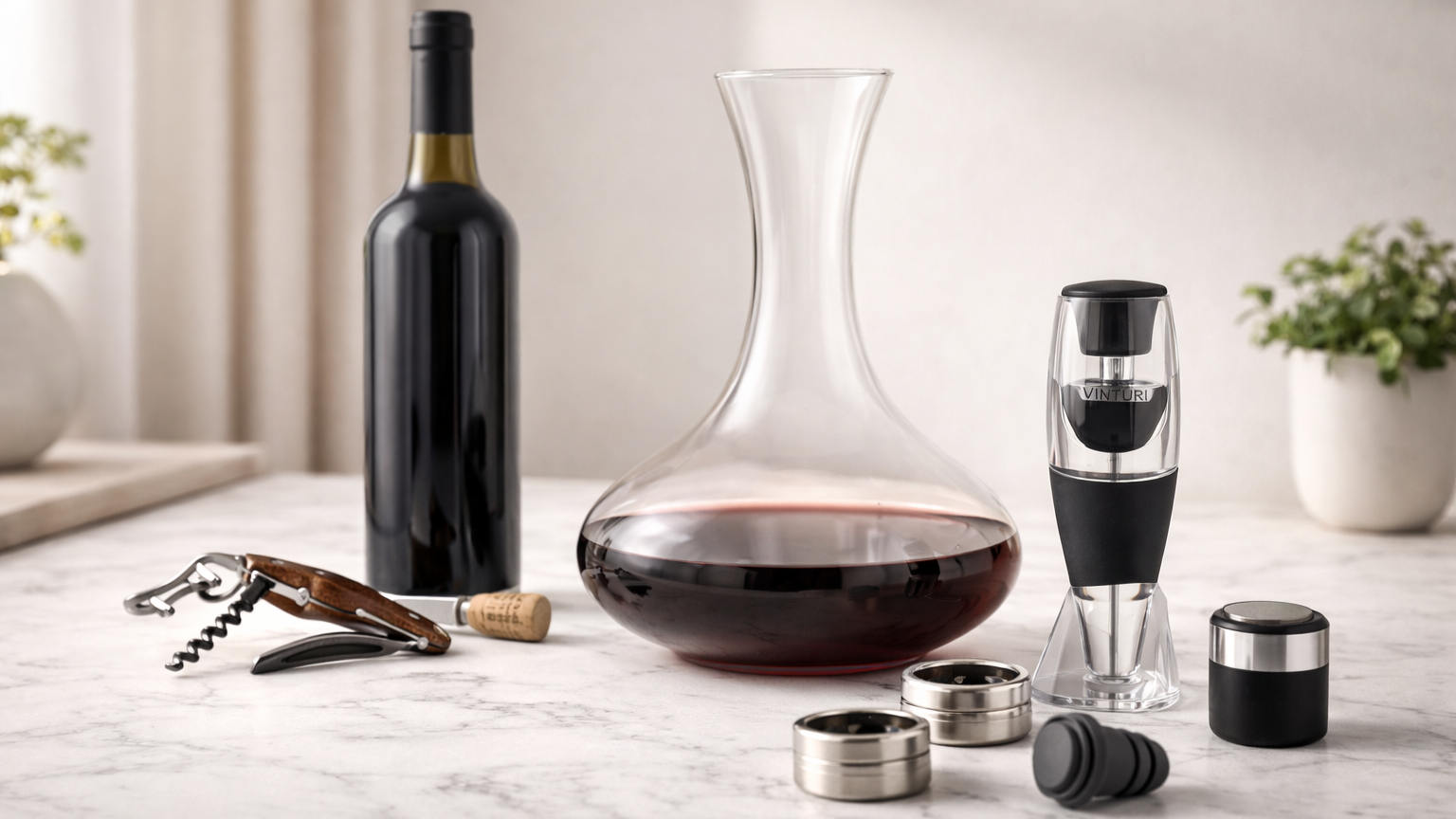
Wine accessories range from genuinely useful tools to gimmicks that mostly collect dust in kitchen drawers.
A few well-designed accessories can noticeably improve the experience of opening, serving, and preserving wine. Others simply complicate something that should stay simple.
The goal of this guide is to highlight the wine tools that actually make a difference in everyday use. These are the accessories that professionals rely on and that home wine drinkers will realistically use again and again.
Affiliate Disclosure: This post may contain affiliate links. As an Amazon Associate and through other affiliate programs, I earn from qualifying purchases at no additional cost to you.
What Wine Accessories Do You Actually Need?
Most wine accessories are optional. In reality, most wine drinkers rely on the same small group of tools over and over.
A good corkscrew is the most important starting point. After that, a simple aerator or decanter can help open up younger wines, and a reliable bottle stopper makes it easier to save the rest of a bottle for later.
Other accessories, like champagne stoppers or quick chilling sleeves, become useful depending on how often you entertain or open sparkling wine.
The goal is not to collect gadgets. It’s simply to have a few practical tools that make opening, serving, and enjoying wine easier.
Wine Accessories at a Glance
| Accessory | Best For | Highlights | |
|---|---|---|---|
| Pulltap’s Double-Hinged Corkscrew Most Essential | Everyday wine opening | Double-hinged lever removes corks smoothly with minimal force | View on Amazon |
| Capabunga Wine Stopper Most Useful | Resealing opened bottles | Flexible silicone stopper allows bottles to lie flat in the fridge | View on Amazon |
| Vinturi Essential Wine Aerator Best Aerator | Fast aeration while pouring | Classic pour-through aerator introduces oxygen instantly | View on Amazon |
| VinoAir Bottle Aerator Pour Spout Easiest to Use | One-handed bottle-mounted aeration | Attaches directly to the bottle for aeration while pouring | View on Amazon |
| Le Chateau Wine Decanter Best Decanter | Aerating young red wines | Wide base increases oxygen exposure to open aromas | View on Amazon |
| Kloveo Champagne Stopper | Preserving sparkling wine | Pressure seal helps maintain carbonation | View on Amazon |
| Vacu Vin Rapid Ice Sleeve Best Value | Quickly chilling wine | Reusable sleeve chills bottles in minutes | View on Amazon |
| Durand Wine Opener Best for Old Wines | Opening fragile aged corks | Dual-support system prevents cork breakage | View on Amazon |
| Ah-So Two-Prong Cork Puller | Budget option for fragile corks | Prongs slide along cork sides for gentle extraction | View on Amazon |
| Cuisinart Electric Wine Opener | Ease of use | Push-button cork removal with charging base and foil cutter | View on Amazon |
| DropStop Wine Pour Disc | Preventing drips | Reusable metal disc stops wine drips while pouring | View on Amazon |
If you only buy a few accessories, start with a good corkscrew, a stopper, and a simple aerator. Those three tools cover most everyday wine situations.
Wine Opening Tools
Best Everyday Corkscrew: Pulltap’s Double-Hinged Waiter’s Corkscrew
A classic waiter’s corkscrew with a double-hinged lever that removes corks in two smooth steps.
Pros
• excellent leverage from double hinge
• compact and durable
• inexpensive
Cons
• requires basic technique
Verdict
The Pulltap’s is the style of corkscrew most sommeliers actually carry. The key feature is the double-hinged lever, which lets you extract the cork in two controlled steps instead of forcing it out in one pull.
That two-stage leverage makes a noticeable difference. The cork comes out smoothly with far less force, and the risk of snapping a cork in half is much lower compared with basic single-hinge corkscrews.
It’s also compact, durable, and inexpensive, which is why professionals use it every day. For most wine drinkers, this is the only wine opener you’ll ever need.
Best Splurge Tool for Fragile Corks: Durand Wine Opener
Designed specifically for opening older bottles with delicate corks.
Pros
• prevents cork breakage
• combines worm and prong extraction
• widely trusted by collectors
Cons
• expensive
Verdict
If you regularly open older bottles, the Durand is genuinely worth the splurge. It combines a traditional corkscrew with Ah-So style prongs so the cork is supported from both the inside and the outside during extraction.
That dual support dramatically reduces the chances of a fragile cork breaking apart or crumbling into the bottle. It’s the reason collectors, sommeliers, and auction houses rely on it when opening mature wines.
If you mostly drink young wines, you may never need one. But if you open aged bottles even occasionally, the Durand is one of the few wine tools that truly earns its price.
Best Budget Tool for Fragile Corks: Ah-So Two-Prong Cork Puller
A classic cork extractor that slides between the cork and bottle.
Pros
• inexpensive
• very compact
• useful backup tool
Cons
• takes practice
Verdict
The Ah-So is the classic budget solution for fragile corks. Instead of drilling into the cork like a traditional corkscrew, the two prongs slide down the sides of the cork and pull it out intact.
It works surprisingly well for many older bottles and costs a fraction of a Durand. The tradeoff is that it relies entirely on the cork still having some structural integrity. If the cork is extremely soft or brittle, the prongs can slip or break it apart.
For occasional use, it’s a great tool to keep on hand. For collectors who open older bottles regularly, the Durand is the more reliable long-term solution.
Electric Wine Opener
Best Electric Wine Opener: Cuisinart Cordless Electric Wine Opener
A rechargeable opener that removes corks automatically.
Pros
• effortless operation
• good for entertaining
• consistent performance
Cons
• larger than manual corkscrews
Verdict
Electric wine openers are less about speed and more about ease of use. With the push of a button, the opener removes the cork automatically without twisting or pulling, which makes it especiallyhelpful for anyone with reduced hand strength, arthritis, or limited wrist mobility.
The rechargeable design keeps things simple, and the charging base includes a built in foil cutter so everything stays in one place on the counter.
The main tradeoff is remembering to keep it charged. If the battery runs down, you are back to opening the bottle manually. For everyday wine drinkers with no mobility concerns, a waiter’s corkscrew is usually faster and takes up less space.
But for anyone who finds traditional corkscrews uncomfortable to use, an electric opener can make opening wine much easier.
Wine Decanters
Best Everyday Wine Decanter: Le Chateau Wine Decanter
A wide-base decanter designed to maximize aeration.
Pros
• large surface area for oxygen
• elegant but affordable
• excellent for young red wines
Cons
• requires careful cleaning
Verdict
The wide base is the reason this decanter works so well. Spreading the wine across a larger surface area exposes more of it to oxygen, which helps soften tannins and open up aromatics in young red wines.
It’s also large enough to comfortably hold a full bottle without feeling oversized on the table. For most wine drinkers, this style strikes the best balance between aeration performance, durability, and price.
If you only own one decanter, this is the style that makes the most practical sense.
Best Space-Saving Wine Decanter: Riedel Cabernet Decanter
A slimmer design that fits easily in cabinets.
Pros
• easier storage
• elegant profile
• trusted brand
Cons
• slightly less aeration surface area
Verdict
The Riedel Cabernet decanter is designed to be easier to live with day to day. Its slimmer shape still allows some aeration while taking up far less space on a table or inside a cabinet than large wide-base decanters.
It’s also easier to handle, pour from, and clean, which makes it a practical option for people who enjoy decanting wine but don’t want a large statement piece sitting around.
While it won’t expose quite as much wine surface area as a broad decanter, it strikes a good balance between function and convenience. For smaller kitchens or more casual use, this style often ends up getting used more frequently.
Best Luxury Wine Decanter: Riedel Amadeo Decanter
A handcrafted crystal decanter with a sculptural design.
Pros
• beautiful centerpiece
• excellent pouring flow
• premium craftsmanship
Cons
• expensive
Verdict
The Amadeo is more about presentation than performance. Its sculptural shape pours beautifully and makes a striking centerpiece on the table, but it doesn’t dramatically outperform simpler wide-base decanters when it comes to aeration.
Where it excels is craftsmanship and design. If you enjoy the ritual of serving wine and want a decanter that feels like a piece of art, this one delivers. For purely functional aeration, however, more affordable decanters work just as well.
Wine Aerators
Best Wine Aerator: Vinturi Essential Wine Aerator
A pour-through aerator that introduces oxygen as the wine enters the glass.
Pros
• instant aeration
• very easy to use
• widely trusted
Cons
• another tool to rinse
Verdict
One of the simplest ways to improve young red wines quickly.
Note
Electric aerators exist, but they offer little real advantage over simple gravity aerators.
Best Bottle-Mounted Wine Aerator: VinoAir Wine Aerator
The VinoAir attaches directly to the bottle and aerates wine automatically as you pour. Instead of holding a separate aerator over the glass, wine flows through the device during the pour, which makes serving easier and more natural at the table.
Pros
• attaches directly to the bottle for one handed pouring
• simple to use when serving multiple glasses
• compact and easy to store
• no need to hold a separate aerator while pouring
Cons
• aeration is slightly less aggressive than larger standalone aerators
• must be rinsed after use to prevent wine residue buildup
Verdict
The VinoAir is all about convenience. Because it stays attached to the bottle, wine aerates automatically while you pour, which makes it much easier to use when serving wine for guests.
Bottle-mounted aerators typically introduce slightly less oxygen than larger handheld designs, but the tradeoff is a much simpler pouring experience. For casual dinners or entertaining, many people end up reaching for this style more often simply because it’s easier to use.
Wine Preservation Accessories
Best Champagne Stopper: Kloveo Champagne Stopper
A clamp-style stopper that preserves carbonation.
Pros
• strong pressure seal
• stainless steel construction
• durable
Cons
• slightly pricier than basic stoppers
Verdict
One of the most reliable champagne stoppers available.
Best Everyday Wine Bottle Stopper: Capabunga Wine Stopper
A flexible silicone stopper designed by Napa Valley winemakers to be completely leakproof.
Pros
• leakproof, bottles can lie on their side in fridge
• dishwasher safe
• very durable
Cons
• does not remove oxygen
Verdict
The most practical everyday wine stopper.
Best Vacuum Wine Saver: Vacu Vin Wine Saver Pump
A hand pump that removes air from the bottle.
Pros
• slows oxidation
• reusable stoppers
• widely trusted brand
Cons
• cannot fully stop oxidation
Verdict
A useful preservation tool for bottles you plan to finish in a day or two.
Temperature & Serving Tools
Best Quick Wine Chilling Tool: Vacu Vin Rapid Ice Sleeve
A freezer sleeve that chills wine in about 10–15 minutes.
Pros
• very fast cooling
• reusable
• compact
Cons
• must be stored in the freezer
Verdict
Perfect when you forget to chill a bottle.
Drip Prevention Tools
Best Wine Pouring Disc: DropStop Wine Pour Disc
A thin metal disc that rolls into the bottle neck to prevent drips.
Pros
• extremely effective
• reusable
• inexpensive
Cons
• easy to misplace
Verdict
One of the simplest wine tools that genuinely works.
Best Adjustable Wine Drip Rings: Stainless Steel Drip Rings
Flexible collars that absorb drips around the bottle neck.
Pros
• fits multiple bottle sizes
• reusable
• simple design
Cons
• less precise than pour discs
Verdict
A classic wine accessory that still works well.
Do You Actually Need All These Wine Accessories?
Probably not.
The most useful tools for most people are:
• a good corkscrew
• a decanter or aerator
• a reliable stopper
Everything else is optional.
The goal is not to fill your kitchen drawer with gadgets. It is to choose a few well-designed tools that genuinely improve how you enjoy wine.
Wine Accessories You Can Skip (Save Your Money)
Not every wine gadget is worth it, and a lot of them are more about novelty than function.
Electric wine aerators sound impressive but don’t make a meaningful difference and tend to break or clog over time.
Ultra-cheap corkscrews are frustrating to use and often fail when you need them most.
Wine glass markers and charms seem helpful but usually smudge, fall off, or just add clutter.
Oversized all-in-one wine tool kits look like a good deal, but most of the pieces go unused and are lower quality than buying a few essentials individually.
Even wine thermometers are unnecessary for everyday use since basic fridge timing gets you close enough.
If an accessory doesn’t clearly make opening, storing, or enjoying wine easier, it’s probably not worth having.
Frequently Asked Questions About Wine Accessories
What wine accessories do you actually need?
Most wine drinkers only need a few basic tools. A good corkscrew is the most important starting point, followed by a bottle stopper for saving unfinished wine. An aerator or decanter can also be helpful for opening up younger red wines. Other accessories like champagne stoppers or chilling sleeves are useful depending on how often you entertain or drink sparkling wine.
Is a wine decanter really necessary?
A decanter isn’t required, but it can improve certain wines. Pouring wine into a decanter increases the surface area exposed to oxygen, which can help soften tannins and release aromas in young red wines. For older wines, decanting is often used simply to separate the wine from sediment.
Do wine aerators actually work?
Yes, wine aerators can work well for quickly exposing wine to oxygen while pouring. They introduce air into the wine stream as it flows into the glass, which can help open aromas and soften structure in young wines. The effect is similar to decanting, but it happens instantly during the pour.
What is the best corkscrew for opening wine?
Most wine professionals prefer a double-hinged waiter’s corkscrew. The two-step hinge provides better leverage, allowing the cork to be removed smoothly with less force. This design is compact, reliable, and inexpensive, which is why it’s widely used by sommeliers and restaurant staff.
How long does wine last after opening?
Most still wines remain enjoyable for one to three days after opening when stored with a stopper and kept in the refrigerator. Lighter wines may fade more quickly, while structured red wines can sometimes last slightly longer. Sparkling wines usually lose carbonation fastest and are best finished within a day.
Do electric wine openers work well?
Electric wine openers remove corks automatically with the press of a button. They are especially helpful for people with limited hand strength, arthritis, or wrist mobility issues. The main downside is that they require charging and take up more counter space than a traditional corkscrew.
Should wine be aerated before drinking?
Many young red wines benefit from aeration because oxygen helps soften tannins and release aromas. This can happen naturally by swirling the wine in a glass, using an aerator, or decanting the bottle. Not every wine requires aeration, but it can noticeably improve some wines.
Where should wine accessories be stored?
Most wine accessories are easiest to store in a small drawer or container near where you open bottles. Many people keep corkscrews, stoppers, and pourers together in a kitchen drawer or home bar area so everything is easy to find when opening a bottle.