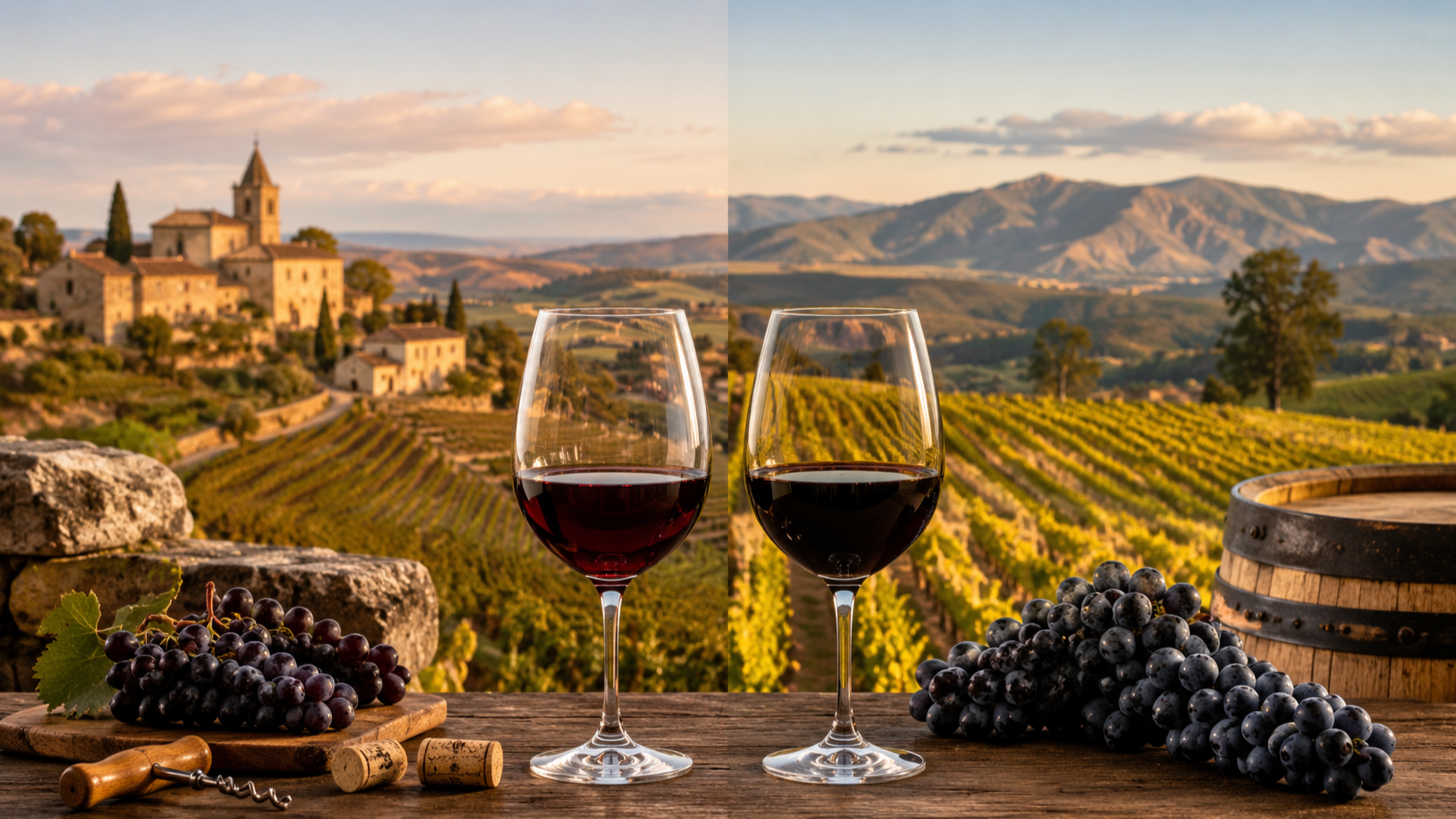
The first distinction most people learn about wine is Old World versus New World. Old World means Europe. New World means pretty much everywhere else, the U.S., Australia, New Zealand, Chile, Argentina.
That's true, but it's also the least useful thing you can know about it.
Put a Bordeaux next to a Napa Cabernet and you'll taste it immediately. The Bordeaux is tighter, more angular, holds back a little. The Napa wine is riper, rounder, gives you everything up front. Same grape. Different wine entirely.
The gap isn't the map. It's climate, regulation, tradition, and a few hundred small decisions made in the vineyard and the cellar before the grapes ever hit a tank. I've made wine in both idioms, cool-climate Pinot off the Sonoma Coast and warmer site Cabernet further inland, and the label "Old World" or "New World" has never once told me what to do with a tank of fruit. It's a style descriptor, not a rulebook. Once you understand what's actually driving the difference, you stop needing the label at all.
Affiliate Disclosure: This post may contain affiliate links. As an Amazon Associate and through other affiliate programs, I earn from qualifying purchases at no additional cost to you.
In This Guide
What Old World and New World wine actually mean
Why wines from different regions taste so different
How climate, tradition, and regulation shape style
Why European labels list a place instead of a grape
Side-by-side comparisons of classic wines from each style
Why the line between the two keeps blurring
How to figure out which style you actually prefer
What "Old World" Wine Means
Old World wine comes from Europe's historic growing regions: France, Italy, Spain, Portugal, Germany, Austria. Bordeaux, Burgundy, Champagne, Rioja, Chianti, Barolo, the Mosel, all Old World.
These regions were making wine long before refrigeration, stainless steel, cultured yeast, or lab analysis existed. Growers figured out what worked through generations of trial and error, then locked it in. Most European producers I've talked with think of themselves less as innovators and more as stewards of a style that predates them. Innovation happens, but the goal is usually to protect what made the place famous, not reinvent it.
What "New World" Wine Means
New World wine is everything outside Europe's traditional regions: the U.S., Australia, New Zealand, Chile, Argentina, South Africa.
Commercial winemaking arrived here later, often after temperature-controlled fermentation, modern sanitation, and real wine science were already available. New World producers weren't inheriting centuries of expectations, so they had more room to experiment: different varieties, different fermentation techniques, new oak programs, vineyard sites nobody had tried before. That freedom is a big part of why California, Australia, and Chile built reputations on bold, fruit-forward wines.
It's not the whole story, though. There's plenty of restrained, low-intervention wine coming out of California and Oregon right now, and plenty of rich, modern-style wine coming out of Rioja and the southern Rhône. Which gets at the real point.
The Labels Describe Tendencies, Not Rules
Take the same grape and plant it in two places. One vineyard sits on a cool, foggy coastline. The other sits inland under long, hot days. Harvest both on the same day, ferment them identically, and they still won't taste the same.
The coastal fruit comes in with brighter acid, lower sugar, more restrained flavor. The inland fruit comes in riper, with more sugar, fuller body, higher potential alcohol. None of that is about a political border. It's about degree days and diurnal swing.
Climate sets the range. Tradition decides what gets planted and how it gets handled. Regulation decides what's even legal to do. Consumer taste shapes stylistic choices on top of that. Harvest date alone can shift a wine's entire personality by a full style category. That's why winemakers think of Old World and New World less as two boxes and more as opposite ends of a spectrum, with most bottles landing somewhere in the middle.
Why They Actually Taste Different
If geography alone decided flavor, every California Cabernet would taste the same, and every French Pinot Noir would taste the same. They don't, because wine is one of the most transparent agricultural products there is. Every input shows up in the glass.
Climate Does Most of the Work
As grapes ripen, four things happen at once: sugar climbs, acid drops, tannins soften, and flavor compounds build. Deciding when to pick is a bet on where that balance lands. Pick too early and the wine is green and sharp. Pick too late and you get low acid, high alcohol, and fruit that tips from fresh into jammy or stewed.
Cooler regions, many classic Old World sites among them, slow that ripening curve down. Grapes hang longer, develop flavor, and hold onto acid. The result reads as fresher, more structured, more built for food.
Warmer regions speed the curve up. Sugar accumulates faster, acid drops faster, and because alcohol comes from yeast converting sugar, the finished wine runs hotter (higher in alcohol). That's a big part of why a Napa Cabernet feels so different from a Bordeaux built from the same two grapes.
Neither is a flaw. They're two different ripeness curves, and a winemaker's whole job during harvest is deciding where on that curve to stop.
Tradition Sets the Target Before Fermentation Starts
Technology isn't the biggest divide between the two styles. Philosophy is.
A grower in Burgundy isn't trying to reinvent Pinot Noir this vintage. They're trying to express Burgundy, which means every decision, from canopy management to when to pick, is aimed at balance and freshness over raw ripeness.
New World producers, without that same weight of precedent, have historically asked different questions: What happens if we pick two weeks later? What if this lot goes into 60% new French oak instead of 20%? Would Grenache do better on this hillside than what's already planted there? That experimentation is a real strength, and it's how a lot of New World regions found their identity in the first place.
Regulation Shapes the Wine Before the Grapes Are Even Planted
This is the part people miss. In much of Europe, appellation systems (AOC in France, DOCG in Italy, DO in Spain) dictate which grapes can go in the ground, maximum yields, minimum aging, even vine spacing. The goal isn't to limit creativity, it's to protect the identity that made the region marketable in the first place. A bottle labeled Chablis has to be 100% Chardonnay from a defined patch of Burgundy. Barolo has to be Nebbiolo from a defined part of Piedmont. The name is doing the work a varietal label would otherwise do.
New World producers generally operate with far fewer constraints. A California winemaker can plant Albariño next to Cabernet, ferment part of the crop in concrete eggs, age the rest in neutral oak, and blend however they want. AVA and labeling rules definitely exist, but they're about geographic origin, or grape variety actually in the bottle, rather than winemaking method. That's a fundamentally looser system, and it's why New World regions can shift style faster than European ones.
Consumer Taste Reinforces the Split
For decades, American drinkers gravitated toward fruit-forward wines with soft tannins and visible oak, wines that were ready to drink the day they were released. European consumers historically treated wine as part of a meal rather than the main event, which put a premium on acid and structure over immediate fruit intensity. That gap has narrowed a lot as tastes have globalized, but it still shows up in how producers on each side approach style by default.
How a Winemaker Actually Thinks About This
On the cellar floor, nobody says "let's make this more Old World." You're making dozens of small calls that nudge the wine in one direction or another: pick this block now or in five days, extend maceration or pull it short, go 100% new oak or blend in neutral barrels, push malolactic fermentation or block it to preserve acid.
Pick earlier, you keep acid and freshness. Pick later, you get riper fruit and more alcohol. More new oak brings vanilla, baking spice, toast. Less oak lets fruit and site character lead. None of these choices are inherently "Old World" or "New World." They just move the finished wine along the same spectrum, and that's exactly why the line between the two categories keeps getting blurrier. A Sonoma producer chasing a Burgundian style and a Bordeaux château leaning into riper, more modern winemaking are pulling the same levers in opposite directions.
What That Means in the Glass
You're not trying to identify a wine's passport. You're picking up on an accent, and no single clue tells the whole story. Start with the wine's overall personality before you get into individual flavors: Does it feel bright and energetic or rich and plush? Is fruit the first thing you notice, or does it share space with acid, tannin, and something more savory? Does it want food, or does it want to be sipped on its own?
Overall structure. Classic Old World wines are usually built around balance: fruit shares the stage with acid, tannin, and texture. New World wines tend to lead with fruit first, then let everything else follow.
Fruit character. Cooler-climate fruit reads as tart cherry, cranberry, red currant, citrus, green apple. Riper, warmer-climate fruit shifts toward blackberry, black cherry, ripe plum, tropical fruit. This is usually the easiest tell for a beginner palate to pick up on.
Acidity. Acid is what keeps a wine feeling alive rather than flat. It declines as grapes ripen, so cooler-climate wines generally hold more of it, which is a big reason they pair so well with rich or fatty food. Warmer-climate wines tend to feel softer and rounder by comparison.
Body and alcohol. More sugar at harvest means more alcohol after fermentation, and more alcohol reads as fuller body. Old World wines often feel medium-bodied even at real concentration. New World wines tend to feel broader on the palate.
Oak. Both traditions use oak. The difference is how loud they let it get. In Europe, oak is usually one ingredient among several, there to add texture and structure without announcing itself. In a lot of New World wine, new oak is part of the appeal, contributing vanilla, baking spice, toast, cocoa, sometimes coffee.
Savory versus fruit-driven. Some Old World wines carry dried herb, tobacco, olive, mushroom, forest floor, leather, developing alongside the fruit rather than replacing it. That's complexity, not a flaw. New World wines usually keep fruit as the lead character for longer before savory notes show up with age.
→ See our beginner’s guide on How to Taste Wine Like a Pro here.
Why French Labels Don't Say the Grape
Most New World wine is labeled by variety: Cabernet Sauvignon, Chardonnay, Pinot Noir, Sauvignon Blanc. The assumption is you're buying it because you recognize the grape.
Old World labels usually name the place instead, because in that system, the place tells you the grape. Bordeaux means Cabernet Sauvignon and Merlot (with a few others). Chablis means Chardonnay. Sancerre means Sauvignon Blanc. Barolo means Nebbiolo. Chianti Classico means mostly Sangiovese. Once you've got a handful of these memorized, restaurant wine lists stop being intimidating.
Four Classic Comparisons
Bordeaux vs. Napa Valley Cabernet Sauvignon. Both built around the same grape, told completely differently. Young Bordeaux is composed: firm tannin, bright acid, cedar, graphite, dried herb, more expressive with food or after time in the glass. Napa Cabernet introduces itself immediately: dark blackberry, richer texture, higher alcohol, more oak up front. One asks for patience, the other usually doesn't make you wait.
Burgundy vs. Oregon Pinot Noir. Pinot shows climate faster than almost any other grape. Red Burgundy leans into elegance: bright cherry, earthy complexity, higher acid, silky tannin. Willamette Valley Pinot keeps a lot of that finesse but runs slightly riper and rounder. These two are cousins, not opposites, which makes them the best entry point for learning the grape.
Sancerre vs. Marlborough Sauvignon Blanc. Same grape, opposite personalities. Sancerre is restrained: citrus, wet stone, fresh herb, cutting acid. Marlborough Sauvignon Blanc is loud: passionfruit, grapefruit, lime, tropical fruit, right at the front of the glass.
Northern Rhône Syrah vs. Australian Shiraz. Same grape, different name, different continent. Northern Rhône Syrah runs toward black pepper, olive, violet, smoked meat. Australian Shiraz runs toward blackberry, plum, chocolate, baking spice, and more weight overall. Tasting these two side by side is one of the fastest ways to understand how much place actually matters.
The Gap Keeps Closing
Thirty years ago these comparisons were more clear cut. Now they're not. California producers are picking earlier, backing off new oak, and chasing freshness. European producers are working with riper fruit in warm vintages and adopting modern cellar techniques their grandparents wouldn't recognize. Consulting winemakers work across continents in the same year. Climate change is pushing everyone, in every region, to rethink harvest timing and canopy management just to hold onto balance. More wines than ever don't fit cleanly into either category, and that's not a problem. The better question isn't which country a wine is from. It's what the winemaker was actually trying to build.
Which Style Should You Start With?
There's no best style, only the one that fits what you're drinking it for. Most experienced wine drinkers don't pick a side, they pick based on the occasion.
Want something bright and structured with dinner? Old World is probably your move. Want something rich and satisfying on its own after a long day? A fruit-forward New World bottle is likely the better call. The more you taste, the more your preference shifts with the season and the plate in front of you.
The fastest way to find your preference: pick one grape and taste two regional expressions side by side, at the same time, before reading any tasting notes.
Cabernet Sauvignon: Left Bank Bordeaux vs. Napa Valley
Pinot Noir: Burgundy vs. Willamette Valley
Sauvignon Blanc: Sancerre vs. Marlborough
Syrah/Shiraz: Northern Rhône vs. Barossa Valley
Ask which one smells more expressive right away, which feels brighter, which has more weight, which you'd drink without food, which makes you want a second glass. There's no wrong answer here. You're calibrating your own palate, not matching someone else's notes.
The Biggest Mistake Beginners Make
Assuming every European wine tastes one way and every wine from California, Australia, or South America tastes the opposite. In reality, there are elegant California Cabernets that would fool people in a blind tasting against Bordeaux, rich modern Bordeaux blends with generous fruit and polished oak, and Australian Chardonnay built on Burgundian restraint. The world's wine regions have never borrowed from each other this much. Old World and New World is a starting point for understanding style, not a final verdict on it.
Frequently Asked Questions
Is Old World wine always made in Europe? Yes. The term refers specifically to Europe's traditional wine-producing countries: France, Italy, Spain, Portugal, Germany, and Austria.
Is California considered New World? Yes, even with a winemaking history over a century old in some cases. New World refers to production regions outside Europe's traditional zones, not to how established a region is.
Why do Old World wines usually taste less fruity? Cooler growing climates slow ripening and preserve acid, which keeps fruit character more restrained. Traditional winemaking philosophy also tends to prioritize balance over maximum ripeness.
Does New World mean sweeter wine? No. New World wines often taste fruitier because the grapes are harvested riper, but the overwhelming majority are still dry, with little to no residual sugar. Fruit intensity and sweetness get confused constantly, but they're not the same thing.
Which style pairs better with food? Both do, for different meals. Higher-acid Old World wines cut through rich or fatty food well because acid resets your palate between bites. Fuller New World wines hold their own against grilled meat, barbecue, and bold, heavily spiced dishes.
Can the same grape really taste completely different? Yes. Cabernet Sauvignon, Chardonnay, Pinot Noir, and Sauvignon Blanc all shift dramatically depending on where they're grown and how they're handled in the cellar. It's one of the reasons wine holds up to a lifetime of tasting without getting boring.
Final Take
Old World and New World aren't a quality ranking, and they're not a rulebook. They're two ends of a spectrum shaped by climate, regulation, tradition, and winemaking philosophy, and most bottles you'll actually drink land somewhere between the two.
Old World wines tend toward freshness, structure, and restraint. New World wines tend toward ripeness, richness, and immediate approachability. The best wines being made right now increasingly borrow from both. As growers adapt to a changing climate and keep learning from each other across continents, that line is only going to keep blurring, which is good news for anyone who likes to drink well.
Next time you're deciding between a Bordeaux and a Napa Cabernet, or a Sancerre and a Marlborough Sauvignon Blanc, skip "which is better." Ask which story you want in your glass tonight.