What Happens After Grapes Are Picked? Inside Wine Harvest Season
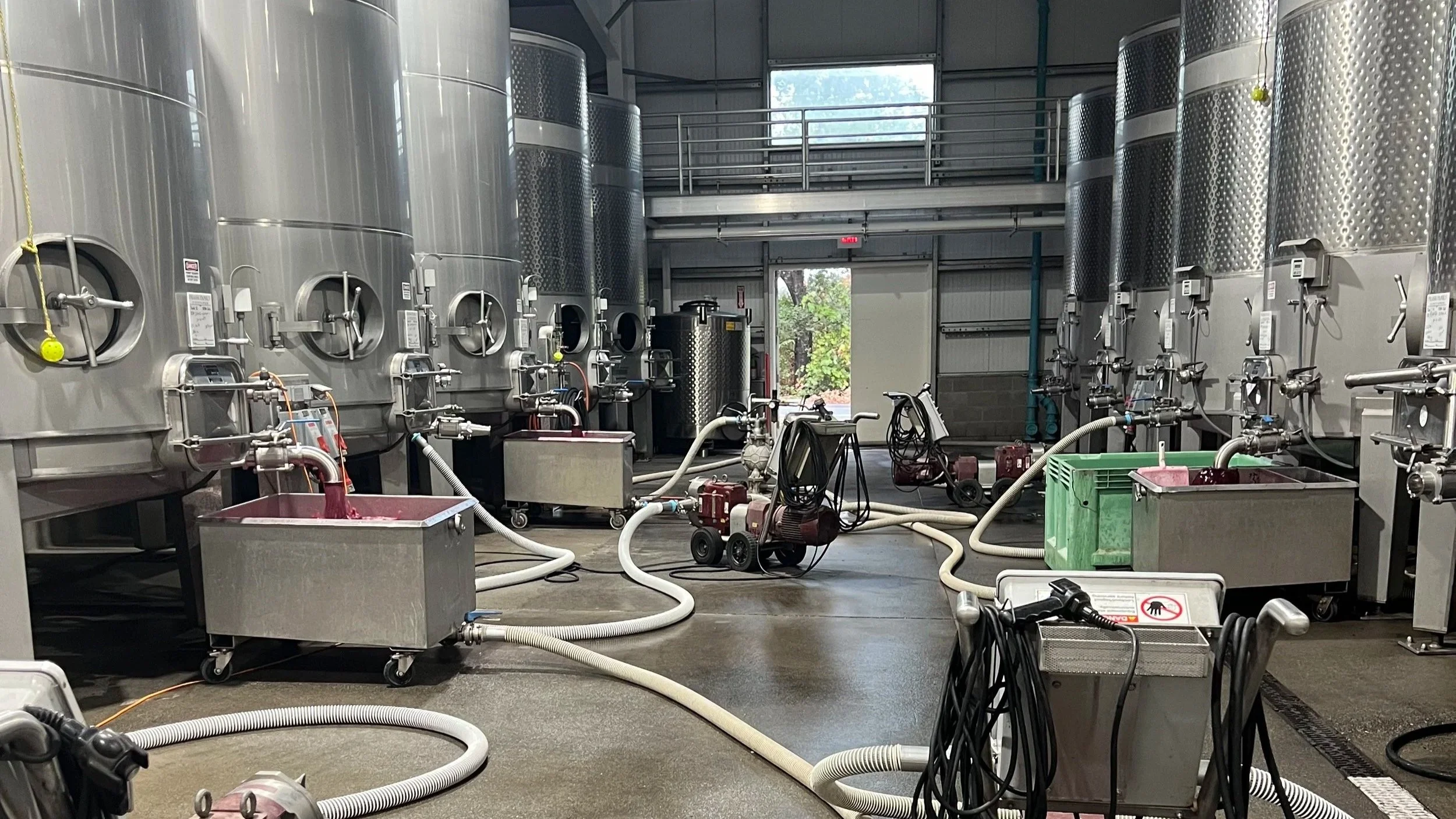
Harvest pump overs in progress
Most of the attention around wine harvest goes to the pick date itself, and that makes sense. When you choose to bring in a block determines the balance, flavor, and acidity of everything that follows.
But the pick date is really just the starting gun. Once fruit leaves the vineyard, it has to get to the winery, get evaluated, get processed, and get moved into the next stage, all while yesterday's fruit is fermenting and tomorrow's is deciding, on its own schedule, whether it's actually ready.
That's harvest.
Picking is the beginning, not the milestone
Harvest is the best time of year to work in a winery. It's also the closest thing the job has to controlled chaos.
For weeks leading up to it, we're out in the vineyard tracking how the fruit is developing: tasting, tracking sugar and acid, watching weather, making calls about which block goes when. Then the grapes start showing up, and they don't wait politely for the last lot to finish.
You can have fruit arriving at the crush pad, a tank being pressed off, and three others actively fermenting, all at the same time. Tanks need to be free when the truck pulls in. Equipment needs to be clean and sanitized. Lab samples keep coming. Current fermentations still need tasting and checking no matter what else is on fire that day.
The vineyard, for its part, does not care what your production calendar says.
The schedule changes constantly
You can plan harvest carefully, but there's only so much precision you can impose on an agricultural product on Mother Nature’s calendar. A weekly picking schedule that looks solid Monday morning can be half-wrong by Wednesday. Fruit ripens faster or slower than expected, a heat spike moves everything up, a block you thought needed another week suddenly tastes ready, the fermentation in the tank you needed isnt ready to press.
It's a little like getting a puppy. You're tired, your calendar isn't yours anymore, and something always needs attention and there is a lot cleaning up. But when the season ends, you forget most of the exhaustion, and when the first grapes show up again the following year and you're right back in it. excited for the new vintage.
Read How Winemakers Decide When to Harvest Grapes for a look at what happens before the first picking crew ever enters the vineyard.
Getting fruit from vine to winery
Once a block is called ready, the next question is how to get it off the vine and into the winery in the shape you need it.
Hand harvesting is still the standard for anything where quality is the priority. A crew moves through the rows cutting clusters and loading them into half-ton bins, small enough that grapes at the bottom aren't getting crushed under their own weight before they even reach the winery.
The real value of hand picking isn't just that a person did it. It's that a good crew is sorting while they harvest. They'll leave behind rot, raisins, obviously unripe clusters, and skip picking up leaves and shoot pieces that would otherwise end up in the fermenter (we call that MOG, material other than grapes). Machines have gotten much better at this, but they still can't match an experienced crew's combination of speed and judgment. Most wine regions depend on skilled seasonal labor for exactly this reason, and that skill doesn't get nearly enough credit.
Machine harvesting has real uses too. Labor can be tight, a block might need to come in overnight, weather might be closing in fast. When you need volume quickly, a mechanical harvester earns its keep.
The tradeoff is fruit condition. Instead of cutting whole clusters, the machine shakes berries loose, and some of those berries break in the process. That means more juice-to-skin contact happening in the field instead of the winery, and more MOG coming in with it.
This matters more for whites than reds. White winemaking generally wants minimal skin contact before pressing, so broken berries in the bin mean earlier oxidation and juice sitting on skins before you've had any say in it. Reds are more forgiving, since skin contact is the point of red winemaking anyway. None of this means whites can't be machine harvested or reds can be handled carelessly, just that broken berries cost you different things depending on the wine.
Why so much picking happens at night. If you've driven through wine country at 3am during harvest and seen a vineyard lit up like a stadium, that's why. Cooler fruit is easier to control once it hits the winery, and in warm regions especially, afternoon-picked fruit can arrive warm enough to complicate everything downstream, faster oxidation, more microbial risk before fermentation even starts. Night picking also just buys more usable hours when the season is moving fast. The cost is that your morning starts a lot earlier than 9am. Harvest hours are a lot closer to 5am to 9pm than what Dolly sang about.
The crush pad: first stop, and it's mostly about identity
The crush pad name is a bit misleading. Not everything that lands there gets crushed. It's really the receiving area, where fruit gets sorted, destemmed, crushed, or sent straight to press depending on what it's going to become.
Before any of that, the winery needs to know exactly what just showed up.
Receiving. Every load has to keep its identity: vineyard, block, variety, quantity, arrival time. This isn't just paperwork. Two Cabernet blocks from neighboring vineyards might get fermented completely separately because they ripened differently or are earmarked for different wines. Keeping lots apart at intake is what lets you evaluate and blend them intelligently later.
Sampling. Brix gets checked first, since it estimates sugar and tells you roughly what fermentation you're walking into. Acid and pH follow. But the numbers are only half the read. You're also looking at the fruit itself: intact or dehydrated, any rot, how much MOG came in, does it match what you saw in the vineyard sample last week. And you taste it. Lab work is useful, but harvest decisions don't become purely numerical just because you're standing next to a refractometer.
Sorting. Ranges from pulling obvious leaves out by hand to running fruit over optical sorters with a full crew watching the belt. The goal isn't a visually perfect berry, it's removing what doesn't belong so the cellar team has full control over what actually goes into the tank.
From here, red, white, and rosé stop being the same process.
Where the paths split: reds, whites, and rosé
There's no single universal sequence where grapes go in one end and wine comes out the other. The real fork in the road is when juice gets separated from skins.
White wine: juice comes off the skins early. Usually whole clusters go straight to press depending on the variety and style. Presses apply controlled pressure, not a smash, letting you decide how hard to push. The juice settles in tank, solids drop out, and you rack (transfer) the clean juice off before fermenting. A crisp Sauvignon Blanc might get a clean, cold stainless fermentation; a barrel-fermented Chardonnay takes a completely different route from there.
Pick → Press → Settle → Rack → Ferment
Red wine: the order flips. Skins stay with the juice through fermentation, because that's where the color and most of the tannin come from. Fruit usually goes through a destemmer, sometimes with a light crush, though plenty of styles deliberately leave berries whole. As fermentation kicks off, CO2 pushes the skins up into a cap that has to be managed, punched down or pumped over, sometimes multiple times a day, and the frequency depends entirely on what that particular tank needs. Once you've pulled the (color, tannin, etc) extraction you want, you drain the free-run wine and press the remaining skins separately.
Pick → Destem/Crush → Ferment on skins → Press
Rosé: usually made from red grapes, but with only hours of skin contact instead of days or weeks. Once you've got the color you want, the juice comes off and finishes fermenting more like a white. Some producers press red grapes directly with almost no contact at all; others pull juice off an active red fermentation via a process known as saignée. Same fruit, wildly different wine, depending entirely on how much time it spent with its skins.
Pick → Limited skin contact/Press → Ferment
And there are always exceptions. Skin-fermented whites, whole-cluster reds with the stems left in, barrel-fermented whites next to stainless tanks in the same cellar. None of that makes one method more advanced than another, they're just different tools for different styles, and during harvest you'll see two loads arrive an hour apart headed for completely different journeys.
Fermentation starts, but the grapes don't stop coming
Getting a lot safely into tank is a small win. It buys you exactly zero time to relax.
Fermentation gets monitored start to finish, and during peak harvest you can have dozens of lots going at once, each on its own timeline. Brix drops as yeast eats sugar, and tracking that drop tells you how the fermentation is moving. Temperature matters just as much, since fermentation generates its own heat and most modern tanks have cooling jackets so you're not just letting a tank run as hot as it wants.
But the spreadsheet only tells you so much. Tasting tells you how the tannin feels, whether the ferment is clean, whether you want more extraction or less. That's the part that stays sensory no matter how much data you're tracking.
Red ferments add the cap management on top: punch-downs or pump-overs, once or several times a day, and it's not the same call for every tank. One lot needs more extraction, another already has plenty of tannin and needs a lighter touch. Eventually you drain the free-run wine and press the rest, and that press wine often tastes noticeably different, enough that a lot of wineries keep the fractions separate and decide later whether or where to blend them back in.
Meanwhile tomorrow's fruit is still on the vine, ripening on its own schedule regardless of how full your cellar already is.
The winery runs several days at once
This is the part that's hard to picture if you haven't lived through a harvest. It's less like a single assembly line and more like a group singing "Row, Row, Row Your Boat" as a round: one group is just starting the first line while another is already three lines in and a third is nearly done, all singing the same song, just badly out of sync with each other on purpose. In the cellar that means fruit arriving at the crush pad, yesterday's Chardonnay settling in tank, a fermentation just getting started, three tanks needing pump-overs today, another two ready to press, and the lab running samples on blocks that haven't even been picked yet, every lot on the same basic path, just at a different verse.
Then someone calls with a change to tomorrow's plan.
Why harvest turns into organized chaos
There's a real plan behind harvest: pick dates, tank schedules, staffing, equipment, trucking, and a spreadsheet that gets more complicated by the day. Then the vineyard does whatever it wants.
You can estimate ripening, but you can't schedule it the way you'd schedule a bottling line. A warm stretch speeds things up, a cool one slows them down, a block that looked days away suddenly tastes ready. Add incoming rain or a heat spike and a winery can decide, overnight, that next week's fruit needs to come in now. That one decision ripples: now you need a crew, bins, trucks, somewhere to put the fruit, and ideally an empty tank.
Tank space becomes Tetris. Having 10,000 gallons of empty tank space doesn't mean you have the right tank space. Lots need to stay separate, tank size has to match the volume, or at least reach the cooling jacket, and a tank that's "almost empty" doesn't help much when a truck is showing up at 7am. You're always thinking two or three moves ahead: what presses off today, what tank does that free up, where does that wine go next, what's coming in tomorrow, what happens if Friday's pick moves to Thursday. Unlike the video game, these pieces are perishable and worth real money if you get the sequencing wrong.
Everything needs cleaning, constantly. Grapes and juice are sticky, fermentation makes its own mess, and presses, hoses, pumps, sorting gear, bins, and tanks all need repeated cleaning and sanitizing. The same piece of equipment can run several different lots in one day, so cleaning isn't a task you get to after the real work, it's part of the real work.
The weekly plan has a short shelf life. You still need one, crews and trucks and tanks can't run purely on improvisation. But treat it as the current best guess, not a commitment. Today's schedule should be solid. Tomorrow's usually is too. Next Tuesday? Ask again Monday evening.
Harvest is a season, not a week
It doesn't happen all at once. A winery might start receiving fruit weeks or months before the last lot comes in, depending on region, varieties, sites, and weather.
Sparkling fruit usually comes in earliest, since you want higher acid and lower sugar than you'd pick for still wine. Early-ripening varieties and cooler sites follow. In Napa and Sonoma, Chardonnay and Pinot Noir can be arriving while Cabernet is still hanging comfortably, and Cabernet from a cooler or later site might not come in for weeks after that. Even two blocks of the same variety can hit ripeness at wildly different times depending on elevation, sun exposure, soil, vine age, crop load, and proximity to the coast.
That staggering means a winery can be at several stages of harvest simultaneously. Early Chardonnay might already be in barrel while Pinot's just getting pressed and Cabernet is only starting to arrive (in an ideal vintage). Tank space that felt generous in week one is usually gone by week four, which is why so much pre-harvest work goes into emptying tanks, bottling the previous vintage, and clearing floor space. You want to start harvest with an empty winery. It won't stay that way long.
Weather can compress the whole thing. A hot stretch accelerates several vineyards at once, or a coming storm pulls a week of scheduled picks into three days. This is when all that planning actually pays off, not because it predicted what would happen, but because it left you room to adjust when it didn't.
What happens to everything that doesn't make it into the bottle
Wine production leaves behind more material than you'd think. After pressing, you're left with pomace (skins, seeds, pulp, sometimes stems), and after a red fermentation, that mass can come out of the press nearly solid.
Pomace doesn't just get thrown away. A lot of it gets composted and eventually goes back into the vineyard as a soil amendment. Some regions send it to distilleries for grappa or similar spirits. Seeds sometimes get pulled for grape-seed oil or other byproducts, though access to those secondary streams varies a lot by facility and region.
Stems from destemmed fruit usually go into composting too, unless a winemaker is deliberately using whole-cluster fermentation, in which case the stems stay in and actually shape the wine's aroma and tannin structure.
Then there's water. Nearly everything that touches grapes or wine needs cleaning and sanitizing, and during harvest that's constant: tanks get emptied, cleaned, sanitized, and refilled while the next truck is already on its way in. That generates wastewater loaded with grape solids, sugar, and cleaning products, which most wineries manage through treatment systems, settling ponds, or filtration, sometimes recycling the treated water for irrigation. Not glamorous, but it's a real cost center and a real part of running harvest responsibly.
When is harvest actually over?
There's usually a moment that feels like the finish line, the last truck of the season pulling away from the crush pad. It isn't, though. Its really like hitting marathon mile 26, and knowing you still have that 0.2 miles to go.
Red fermentations can run for days or weeks after that. Tanks still need pump-overs, wine still needs pressing, whites might still be actively fermenting in tank or barrel. Then most reds and some whites like Chardonnay go through malolactic fermentation (ML), where bacteria convert sharp malic acid into softer lactic acid, changing texture and softening acidity. Some wines (usually whites) are deliberately kept from finishing ML to preserve brightness; others are pushed through it. Either way, it's another process to track.
As fermentations wrap, the winery shifts from harvest mode into cellar mode. Wine moves into barrel, barrels get topped to replace evaporation loss, lots get tasted and evaluated, and early blending decisions start even though most wines are still a long way from final. The trucks stop showing up at dawn, the crush pad gets cleaned down, equipment put away, and the pace changes noticeably.
Ask the vineyard crew when harvest ends and they'll say when the last grapes came off the vine. Ask the cellar team and they'll say once the last red is pressed and the new wine is settled into tank and barrel. Ask the winemaker and the honest answer is that the vintage isn't finished for a long time yet. Harvest is just the short, intense window where a year's worth of vineyard work becomes young wine.
Wine harvest at a glance
The core difference between white and red winemaking comes down to one thing: when juice and skins get separated.
White: Pick → Receive & Sort → Press → Settle Juice → Ferment → Tank or Barrel → Aging
Red: Pick → Receive & Sort → Destem/Crush → Ferment With Skins → Press → Tank or Barrel → Aging
Rosé: Pick → Receive & Sort → Limited Skin Contact/Press → Ferment → Tank or Barrel → Aging
Whole-cluster ferments, skin-contact whites, direct-press rosé, and barrel-fermented whites all bend these paths, but this covers the basic map.
FAQ
How fast are grapes processed after picking? As fast as the intended style requires. Some fruit goes almost straight to press or tank; other lots are held deliberately under controlled conditions before the next step. The key is that any delay is intentional, not just fruit sitting around because there's nowhere to put it yet.
Are wine grapes washed? No. Washing adds water and dilutes juice, and it strips natural material off the skin that some winemakers actually want present. Fruit quality gets managed through vineyard practice, sorting, and winery sanitation instead.
What does "crush" actually mean? It refers to physically breaking berries, but the industry also uses it loosely for the whole harvest season, and the crush pad is just the receiving area. Not everything that lands there literally gets crushed.
Why pick at night? Cooler fruit, more control during processing, less risk of oxidation or microbial activity before fermentation starts. Common practice in warm regions during peak season.
How long does harvest last? No fixed length. Sparkling fruit comes in early, later red varieties can hang for months longer, and a winery working multiple vineyards and varieties can be picking across several months total.
What's MOG? Material other than grapes, leaves, shoot pieces, and other vineyard debris that shouldn't end up in the fermenter. Careful hand picking and sorting keep it out.
What happens to skins after pressing? They become pomace, which can be composted, returned to the vineyard, sent to distillers, or used for grape-seed oil, depending on the winery and region.
Is it wine yet during harvest? Technically, once alcoholic fermentation finishes, yes. But it's young wine, not finished wine, and it's still got malolactic fermentation, aging, blending, clarification, and stabilization ahead of it before bottling.
From vineyard to cellar
Before harvest, everything revolves around the vineyard: watching the vines, tracking weather, tasting fruit, checking chemistry, deciding when it's finally time. Once that call is made, the pace changes fast. A cluster on the vine in the morning can be in tank by afternoon.
Multiply that across dozens of blocks arriving on different days, each headed down a different path, and you start to understand harvest's reputation. It's agriculture, logistics, chemistry, sensory work, and a lot of people trying to stay one step ahead of a crop that doesn't care about your spreadsheet, vineyard crews picking in the middle of the night, drivers getting fruit to the winery, cellar teams processing it, lab teams running samples nonstop.
There's real romance to harvest, and some of it's earned. Watching a year of vineyard work finally show up at the winery is genuinely exciting. It's also sticky, exhausting, and held together by a schedule everyone knows will change by Wednesday and a whole lot of caffeine.
Eventually the last truck leaves, the presses go quiet, fermentations finish, and the winery gets noticeably calmer. Outside, the vines start shutting down for the year. Inside, a whole new vintage is just getting started.
Related Guides
Wine Fridges Explained - How to Choose the Best One
Best Wine/Bar Cabinets for a Home Bar
The Best Budget Wine Glasses That Don’t Feel Cheap
Best Large Wine Fridges for Serious Collectors (150+ Bottles)
Best Walkable Wine Towns For a Weekend Trip (US Version)
Bucket List Wine Hotels Around the World
Best Places to Stay for Wine Tasting: