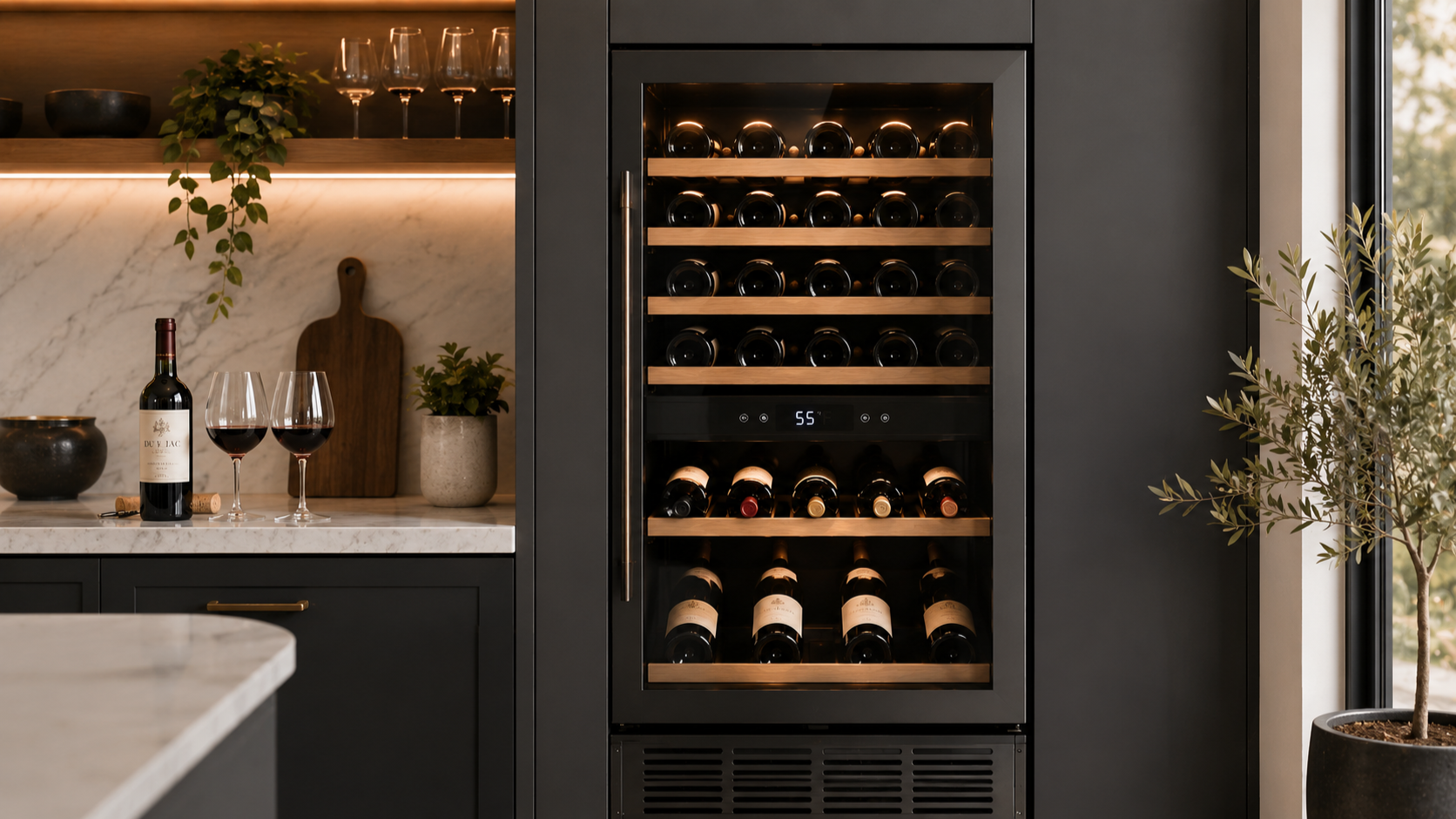
Shopping for a wine fridge should be simple. It isn't. You're suddenly comparing compressor vs thermoelectric cooling, single zone vs dual zone, built-in vs freestanding, and bottle capacities that all claim to fit "50 bottles" but somehow never do.
Most people either buy the wrong wine fridge or outgrow it within a year. This guide covers every major decision point so you get it right the first time — without wading through spec sheets.
Affiliate Disclosure: This post may contain affiliate links. As an Amazon Associate and through other affiliate programs, I earn from qualifying purchases at no additional cost to you.
In This Guide
Do You Actually Need a Wine Fridge?
Not everyone does. But most people benefit from one earlier than they expect.
Wine is sensitive to temperature swings, UV light, humidity changes, and vibration. Even affordable bottles can taste dull or prematurely aged after months of poor storage. The biggest culprit in most homes isn't neglect — it's temperature instability.
A cabinet next to an oven, a sunny countertop, or the top of a refrigerator can experience significant daily temperature swings. Repeated heat cycling is one of the fastest ways to shorten a wine's lifespan, regardless of what you paid for it.
If you buy a bottle for the weekend and drink it within a few days, you probably don't need a dedicated wine fridge. But one starts making real sense if you:
Regularly keep more than a few bottles at home
Buy wine in multiples or by the case
Want wine served at the right temperature without thinking about it
Live in a warm climate
Entertain with wine regularly
Are starting a collection of any size
Not ready for a dedicated unit yet? Our guide to storing wine without a wine fridge covers better short-term options.
The 6 Things That Actually Matter When Choosing a Wine Fridge
Most wine fridge specs are noise. These are the decisions that actually affect how well a unit works in a real home.
1. Capacity: Buy Bigger Than You Think You Need
This is the most common mistake buyers make.
Advertised bottle counts are almost always optimistic. They assume every bottle is a standard Bordeaux shape. Pinot Noir, Champagne, and many Napa Cabernet bottles are wider and meaningfully reduce usable capacity. A fridge marketed as a 24-bottle unit may realistically hold considerably fewer from a typical mixed collection.
Wine collections also grow faster than most people expect. A few wine club shipments, a case purchase, and a couple of holiday hauls can fill a small unit within a year.
Wine HabitRecommended CapacityOccasional wine drinker8–18 bottlesRegular wine drinker20–40 bottlesEntertaining often40–80 bottlesGrowing collection80+ bottles
If you're torn between two sizes, go larger. You won't regret the extra space. You will regret running out of it.
For a full breakdown including bottle shape considerations, see our wine fridge capacity guide.
General Capacity guidelines:
| Wine Collection Size | Recommended Capacity |
|---|---|
| Occasional wine drinker | 8–18 bottles |
| Regular wine drinker | 20–40 bottles |
| Entertaining often | 40–80 bottles |
| Growing collection | 80+ bottles |
2. Single Zone vs Dual Zone Wine Fridges
This is the decision most buyers overthink.
Single zone wine fridges maintain one consistent temperature throughout the unit. They're simpler, less expensive, more energy efficient, and genuinely the better choice if you mostly drink one type of wine or want reliable long-term storage conditions.
Dual zone wine fridges split into two independently controlled sections — useful if you regularly drink both reds and whites and want them at serving temperature without adjusting settings before every meal or dinner party.
The honest truth: a lot of buyers pay the premium for dual zone and rarely use the two zones at meaningfully different temperatures. For casual wine drinkers, a quality single zone unit is usually the smarter investment.
Dual zone earns its price when entertaining frequency is high, or when the difference between a properly chilled white and a too-warm red would genuinely bother you or your guests.
Our full single zone vs dual zone comparison goes deeper if you're undecided.
3. Compressor vs Thermoelectric Cooling
This is where marketing and real-world performance diverge most.
Thermoelectric wine fridges are quiet, vibration-free, and energy efficient. On paper, that sounds ideal. In practice, they have one meaningful limitation: they struggle to maintain target temperatures when ambient room temperature climbs. In a warm kitchen, an uninsulated garage, or any space without reliable climate control, a thermoelectric unit can fail to cool adequately.
They work well in specific conditions — small units, cool stable rooms, mild climates. Outside of those conditions, they underperform.
Compressor wine fridges handle real-world conditions far better. They cool more effectively, maintain temperature more consistently across ambient temperature changes, and scale to larger capacities without issue. Older concerns about compressor vibration are largely overstated in modern units — the practical difference for most wines is negligible.
For most homes, a compressor wine fridge is the more reliable and versatile choice. The only buyers who should seriously consider thermoelectric are those with small collections in consistently cool, climate-controlled spaces where noise is a priority concern.
Read our full thermoelectric vs compressor wine fridge comparison for a complete breakdown.
4. Built-In vs Freestanding Wine Fridges
This decision comes down entirely to where the unit will live.
Built-in wine fridges are engineered with front ventilation so they can sit flush inside cabinetry without overheating. They're well suited for kitchen renovations, home bars, and permanent installations. They cost more because front-venting requires more sophisticated thermal engineering.
Freestanding wine fridges vent from the sides or rear and need clearance around the cabinet. They're more affordable, available in far more sizes, easier to relocate, and the right call for most apartments, rentals, and flexible setups.
One rule worth stating clearly: never install a freestanding wine fridge inside cabinetry unless the manufacturer explicitly approves it. Poor ventilation causes overheating, reduces cooling efficiency, and significantly shortens compressor lifespan. It's a common mistake that looks fine initially and causes real problems over time.
For installation-specific guidance, see our best built-in wine fridges for modern kitchens guide.
5. Noise and Placement
Wine fridges are not silent. Some are impressively quiet; others cycle audibly enough to become a genuine nuisance in a small apartment or open-concept home.
Noise matters most if the unit will be near a bedroom, in a studio apartment, beside a dining table, or in a quiet office. Check decibel ratings where available, and look for reviews that specifically mention noise — manufacturer specs tend to be optimistic here.
Placement affects performance as much as noise. Avoid:
Direct sunlight
Proximity to ovens, dishwashers, or other heat-generating appliances
Uninsulated garages unless the unit is specifically rated for elevated ambient temperatures
Spots without adequate clearance for airflow
A wine fridge tucked into a tight corner with no ventilation space will cool less efficiently and wear out faster. Function has to come before aesthetics here.
6. Shelving Design
This gets less attention than it deserves. A wine fridge can technically reach its advertised bottle count while being genuinely frustrating to use daily.
Poor shelf design leads to stuck bottles, wasted vertical space, and difficulty fitting anything wider than a standard Bordeaux. If you regularly drink Pinot Noir, Champagne, or Rhône-style bottles, shelf configuration matters as much as total capacity.
Look for removable shelves, smooth sliding racks, and wider shelf spacing for larger bottles. Be skeptical of any unit that hits a high bottle count by assuming every bottle is the same shape. Real-world capacity is always lower.
Which Wine Fridge Is Right for You
Small apartments or condos: A compact freestanding or countertop unit with quiet operation and a slim footprint. See our guide on the best countertop wine fridges for apartments and small kitchens.
Casual wine drinkers: A single zone compressor fridge. You don't need dual zone, premium shelving, or collector-level capacity. Focus on reliable cooling and a practical size.
Growing wine collections: Skip the starter-size models. Mid-size compressor units in the 40–80 bottle range offer the best balance of flexibility, value, and room to grow. Our best wine fridges for home use guide covers the top picks in this range.
Frequent entertainers: Dual zone becomes genuinely useful here. Serving whites too warm or reds too cold is one of the most common hosting mistakes, and a dual zone setup eliminates the problem without any pre-dinner juggling.
Serious aging: Temperature stability is the priority. Compressor cooling, meaningful UV protection, and build quality matter more than features. This is where premium brands start to justify higher prices. Our best wine fridges under $500 guide identifies the strongest performers before the price jumps into luxury territory.
Garages or warm rooms: Avoid thermoelectric entirely. Warm ambient temperatures overwhelm most thermoelectric systems quickly. Look for compressor cooling, strong insulation, and a garage-rated model if possible.
Common Wine Fridge Buying Mistakes
Buying too small. The most common mistake and the most avoidable. Assume your collection will grow faster than you expect.
Prioritizing looks over cooling performance. A wine fridge that struggles to hold temperature is expensive furniture. Aesthetics matter, but they shouldn't drive the decision.
Assuming dual zone is always better. It's useful for specific buyers and unnecessary for many others. Don't pay for it if you won't use it.
Ignoring bottle shapes. Champagne and Burgundy bottles reduce real-world capacity faster than most buyers account for.
Installing a freestanding unit inside cabinetry. This causes overheating and kills compressors prematurely.
Putting a standard wine fridge in a hot garage. Most units aren't designed for elevated ambient temperatures. Check the spec before you place it.
Confusing storage temperature with serving temperature. A unit optimized for serving isn't necessarily optimized for long-term aging, and vice versa. Know which you need before you buy.
For a more complete list, see our common wine storage mistakes guide.
Are Expensive Wine Fridges Worth It?
Sometimes. More expensive units generally offer better temperature consistency, compressor quality, UV protection, vibration control, lower noise levels, and longer lifespan. Those things matter — but the returns diminish quickly past a certain price point.
For most buyers, a solid mid-range compressor fridge delivers the best balance of performance and value. Premium brands make more sense for built-in cabinetry installations, large collections, and serious long-term aging goals. For casual wine drinkers, spending significantly more rarely delivers meaningfully better results day to day.
If budget is a constraint, our best wine fridges under $500 guide identifies the strongest performers in that range.
Quick Wine Fridge Buying Recommendations
| If You Want... | Look For... |
|---|---|
| Small kitchen setup | Compact freestanding or countertop fridge |
| Mostly red wine storage | Single zone wine fridge |
| Both reds and whites ready to serve | Dual zone wine fridge |
| Garage placement | Compressor cooling |
| Built-in kitchen installation | Front-venting built-in model |
| Long-term flexibility | Larger capacity than you currently need |
FAQ
What size wine fridge should I buy? Larger than you think you need. Advertised bottle counts are optimistic, real-world capacity is lower due to bottle shape variation, and collections grow faster than most people expect. When in doubt, go bigger.
Is dual zone worth it? If you regularly drink both reds and whites and want them at serving temperature without adjusting settings, yes. For most casual wine drinkers, a quality single zone unit is completely sufficient and better value.
Are thermoelectric wine fridges good? In cool, stable indoor environments with smaller collections, yes. In most real-world home conditions — especially warm kitchens, garages, or hot climates — compressor units perform significantly better.
Can you store red and white wine together? Yes. Long-term storage temperature matters more than maintaining separate serving zones. A consistent, cool environment is more important than perfect zone separation.
Can I put a wine fridge in the garage? Only if the model is rated for elevated ambient temperatures. Standard units struggle in garages, particularly during summer months.
How long do wine fridges last? Most quality units last 8–15 years depending on build quality, placement, and maintenance.
Do wine fridges use a lot of electricity? Most modern units are relatively energy efficient. Check the annual kWh estimate in the product specs — it varies significantly by size and cooling type.
What's the difference between a wine fridge and a regular refrigerator? A standard refrigerator runs too cold (35–38°F) and too dry for wine storage. Wine fridges maintain the 45–65°F range appropriate for both storage and serving, with higher humidity to protect corks and UV-filtering glass to limit light damage.